Noritake marks: how to read and date the backstamp
Read the mark in three parts
Noritake grew out of Morimura Brothers, a trading firm Ichizaemon Morimura founded in 1876 with a shop in New York. In 1904 the family set up their own porcelain company, Nippon Toki Gomei Kaisha, at the village of Noritake near Nagoya, and in 1914 it finished Japan's first Western-style dinner set for export to the United States. The company only took the name Noritake Co., Limited in 1981.
Collectors count more than 400 different Noritake backstamps, so don't try to match yours picture by picture. Read it in three parts instead:
- The country word. NIPPON, JAPAN, MADE IN JAPAN or OCCUPIED JAPAN. This gives the widest date range.
- The symbol. An M in a laurel wreath (for Morimura), an N in a wreath (for Noritake), a maple leaf, the letters RC, or a round crest that looks like a stylised tree. Noritake calls that crest the Maruki; older books call it the Komaru.
- The words around it. NORITAKE, HAND PAINTED, ROSE CHINA, a pattern name or a pattern number, often in a banner under the main mark.
Date it from the mark
The country word changed with American import law. Under the McKinley Tariff Act of 1890, imports had to name their country of origin, and Japanese exporters used NIPPON. In 1921 the rule changed to require English, so marks after that say JAPAN or MADE IN JAPAN. Noritake's exports to the United States stopped in 1941 and didn't resume until 1948, during the Allied occupation of Japan.
| What the mark shows | Roughly when |
|---|---|
| NIPPON alone, or Nippon brushed in Japanese characters | 1921 or earlier; not proof of Noritake |
| Maple leaf with NIPPON | About 1891 to 1911 |
| Maruki (Komaru) crest with NIPPON | The crest was first registered in 1908; this version probably 1910s |
| RC (Royal Crockery) or a rising sun, with NIPPON | From about 1911 |
| M in a wreath, HAND PAINTED above, NIPPON below | 1911 to 1921 |
| M in a wreath, NORITAKE above, HAND PAINTED and MADE IN JAPAN below, often in green | Early 1920s to about 1940 |
| The same mark with a pattern name, number, or "design patent applied for" | 1920s and 1930s |
| ROSE CHINA with a rose, MADE IN JAPAN or MADE IN OCCUPIED JAPAN | Just after the war, from about 1946 (see below) |
| Maruki crest with Noritaké in script and MADE IN OCCUPIED JAPAN | 1947 |
| NORITAKE mark with OCCUPIED JAPAN or MADE IN OCCUPIED JAPAN | 1948 to 1952 |
| Maruki crest with NIPPON TOKI KAISHA | Registered 1949; the name was dropped in 1963 |
| N in a wreath, Noritake in script, JAPAN | 1953 to today |
| NORITAKE IVORY CHINA with an N | From 1962 |
| CONTEMPORARY BY NORITAKE, LEGACY BY NORITAKE, NORITAKE IRELAND | First used 1970, 1977 and 1977 |
| NORITAKE BONE CHINA, an urn in a wreath | Modern; Noritake began making bone china in 1932 |
The quickest single test is the letter in the wreath: an M means before 1953, an N means 1953 or later. Noritake also set up a tableware factory in Sri Lanka in 1972, so on a modern piece read the country as well as the brand.
Where the references disagree
The standard references give different years for some marks. Where they differ, the table above uses the range they share:
| Question | What the references say |
|---|---|
| When the M in a wreath began | 1911, the year of the first U.S. registration (the Nippon collectors' club, Invaluable and gotheborg.com's mark notes); about 1914, when export dinnerware began (gotheborg.com's history text) |
| When it ended | 1921 on NIPPON pieces; about 1940 or the Second World War on MADE IN JAPAN export pieces; 1953, when the N replaced it (Noritake Australia, gotheborg.com). These fit if they describe different versions of the mark. |
| The first RC mark | Registered in Japan in 1907 or 1908 |
| Occupied Japan | 1947 to 1952, or 1948 to 1952; the occupation itself ran from 1945 to early 1952 |
| Rose China | 1945 to 1948, from 1946, or about 1947 to 1953, all on the same reference page |
| The M in an upside-down wreath | Morimura, according to collector books by Joan Oates and Aimee Neff Aldren; not listed by Joan Van Patten, whose mark books collectors rely on; doubted by gotheborg.com, which suggests the 1930s to 1950s |
Noritake or a look-alike?
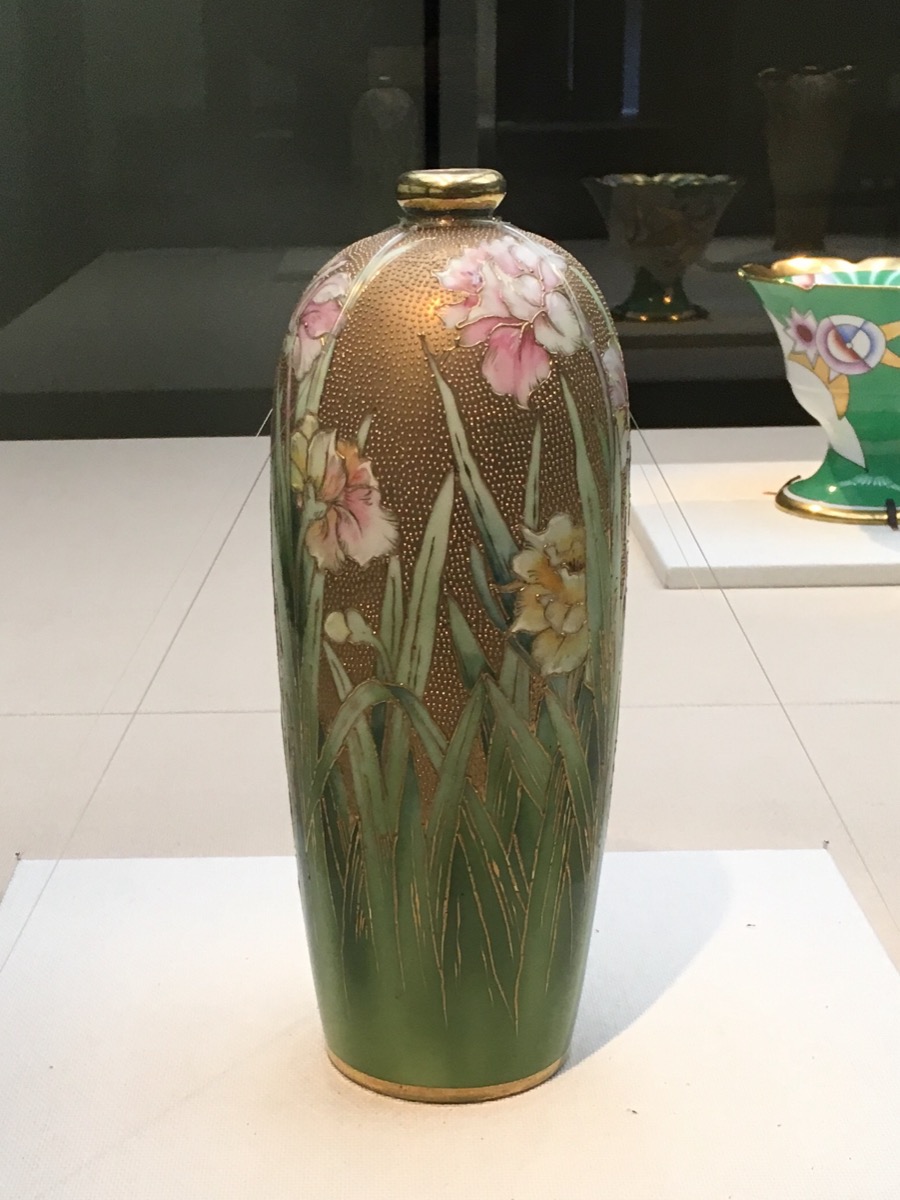

- NIPPON on its own is a country, not a maker. Until 1921 Japanese exporters of all kinds marked their goods that way. Without the M in a wreath, the maple leaf, RC or the Maruki crest, a Nippon piece may come from any of many other firms.
- The M in a wreath has been faked. Nippon collecting took off in the 1970s, and by the 1980s fakes were being made to meet the demand. The first fake marks copied Morimura's, and later copies of the M in a wreath are close enough to fool experienced collectors. Thanks to Noritake's efforts, U.S. Customs ruled the fake mark counterfeit, so importers switched to paper labels that peel off.
- Check the piece, not just the mark. The International Nippon Collectors Club says genuine M-in-wreath and RC porcelain is bright white, thin, light and translucent, with lustrous gold that has a warm patina and an even, smooth glaze. Fakes tend to have flat, dull painting and brassy, harsh gold. Some forms, such as oyster plates, kerosene lamps and wine coolers, were never sent to the U.S. in the Nippon era at all.
- The upside-down wreath is disputed (see the table above). Price it as possibly Noritake, not certainly.
- Rose China is genuine Noritake. Just after the war the company kept its name off china it thought below prewar standard and sold it as Rose China instead.
- "Heinz and Co. 1984 Noritake Japan" marks the 1984 reissue of Frank Lloyd Wright's Imperial Hotel china, not the hotel's original service.
Noritake's Australian site warns that its backstamps have occasionally been copied or added to pieces it didn't make, and that the quality and style should match the era the mark claims.
Patterns and pieces collectors pay for
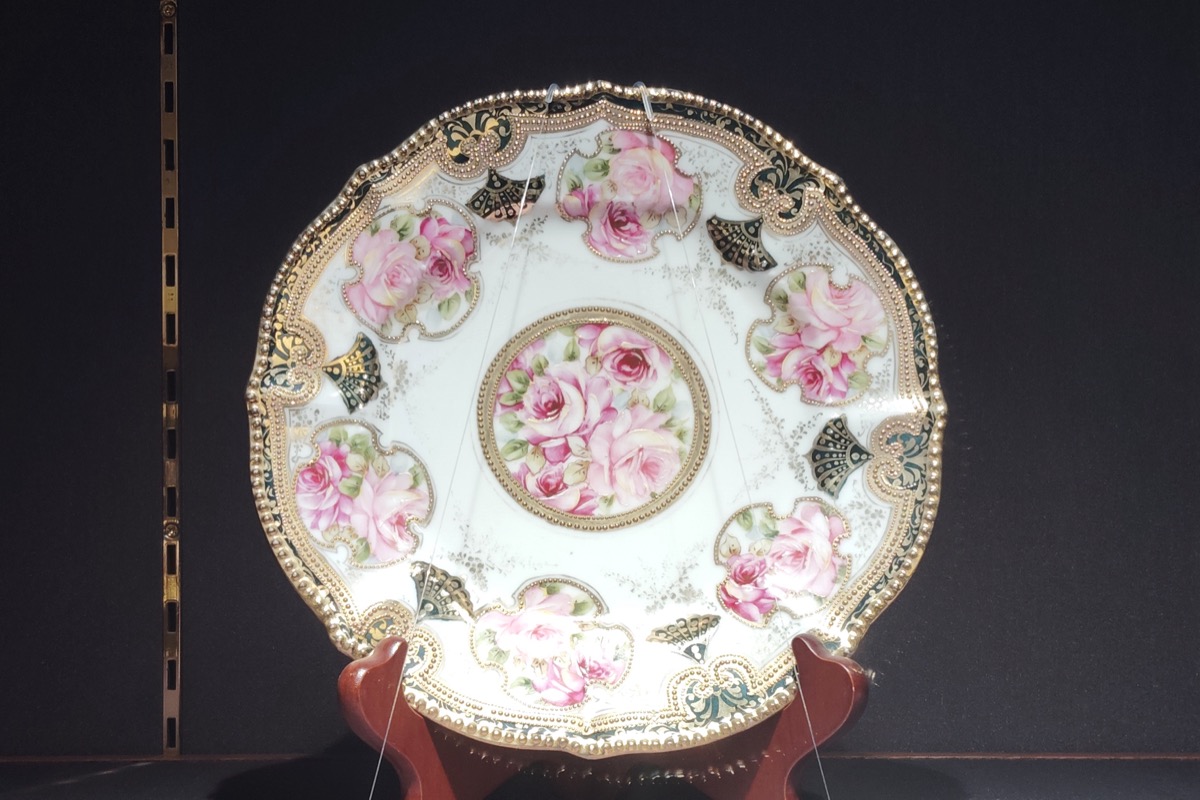

- Hand-painted Nippon-era pieces from Morimura, especially vases with fine painting, gold and raised (moriage) decoration. Nippon by other firms varies much more in quality, and prices vary with it.
- Azalea, made from about 1915 to 1930 and sold through the Larkin Company of Buffalo, New York, as a premium. The rare shapes are the bulbous vase, the pancake jug, the china ashtray and the 15-piece child's set.
- Tree in the Meadow, another early pattern, common and usually inexpensive.
- Lusterware, a thin metallic glaze over a bright colour, often with Art Deco designs, mostly from 1921 to 1941. Figural pieces, such as a lady in a gown that lifts off to reveal an inkwell, sell well.
- Frank Lloyd Wright's Imperial Hotel china, designed for the hotel in Tokyo and reissued by Noritake in 1984 with a Heinz and Co. mark. The auction houses below date the design to 1913 and to 1922.
Rather check yours from a photo? Worthzy identifies the piece, screens it for fakes and shows a price range from matching listings, in seconds.
Get Worthzy on the App StoreWhat Noritake sells for
These are typical eBay sold prices gathered by the price tracker Underpriced AI on pages updated between August and October 2026. We couldn't check them against eBay directly, so treat them as a guide.
| Piece | Typical sold | Range | Sales |
|---|---|---|---|
| Morimura Brothers Nippon berry bowls, set of 4 | $22.49 | $7 to $399.99 | 19 |
| Lusterware two-handled serving bowl, peach with black rim | $23.20 | $9.95 to $525 | 44 |
| Bluebell (pattern 5558) luncheon set, 15 pieces | $32.25 | $18 to $350 | 56 |
A lusterware lady inkwell from about 1925, marked with the green M in a wreath, NORITAKE, HAND PAINTED and MADE IN JAPAN, has sold six times since 2023, as recorded by the Society of Inkwell Collectors: $230 in May 2023, $261 in October 2023, $161 in August 2024, $125 in September 2024, $124 in December 2024 and $160 in October 2025.
Auction results:
| Piece and mark | Sale | Result |
|---|---|---|
| Frank Lloyd Wright Imperial Hotel service, 64 pieces, each stamped "Heinz and Co. 1984 Noritake Japan" | Wright, Chicago, 26 March 2020 | $6,250 |
| Frank Lloyd Wright Imperial Hotel service, 40 pieces, retailed by Tiffany & Co. | Toomey & Co., March 2019 | $5,000 |
| Frank Lloyd Wright Imperial Hotel service for eight, 45 pieces, marked Heinz and Co./Noritake/Japan/1984 | Rago, 22 January 2017 | $2,000 |
| Lusterware punch bowl set, 15 pieces | Akiba Antiques, July 2021 | $260 |
| Nippon vase with moriage, roses and a lake, green Morimura wreath mark, 9¼ inches | Soulis Auctions, 21 May 2017 | $50 hammer |
| Azalea teapot from a 13-piece set | Florida Estate Sales, April 2021 | $45 |
| Tree in the Meadow tea set, 21 pieces | Keystone Auctions, February 2020 | $40 |
The Nippon vase sold below its $80 to $120 estimate despite a genuine Morimura mark and no damage: the mark proves who made a piece, but decoration, size and condition set the price.
How to check what yours sells for
- Write down every word in the mark, its colour, and any pattern name or number. The pattern number is the fastest way to find matching pieces.
- Search eBay for "Noritake" with the pattern name or number, or the mark and shape for unnamed Nippon pieces, and filter by Sold Items. Ignore asking prices.
- Compare pieces of the same shape and size, and check sold photos for chips, cracks and worn gold.
- For a Nippon piece you think is important, compare its mark with the International Nippon Collectors Club's backstamp guides, and ask a dealer or auction house that knows Japanese porcelain before you sell.
- Other makers' marks are in our guide to pottery and porcelain marks, and a full dinner service is covered in is my china worth anything?
Sources
- History of Noritake, Noritake Co., Limited
- Historical record, Noritake Co., Limited
- Identify Your Noritake, Noritake Australia
- Japanese porcelain marks: Noritake (Morimura Bros.), gotheborg.com
- Reproduction, fake and fantasy Nippon, International Nippon Collectors Club
- Guide to Noritake China Value and Patterns, Invaluable
- Noritake Lusterware Lady in a Gown, Society of Inkwell Collectors
- Frank Lloyd Wright, Imperial Hotel dinnerware, lot 124, Wright
- Frank Lloyd Wright dinnerware, lot 1220, Rago
- A good Nippon porcelain vase with moriage, lot 279, Soulis Auctions
- Noritake lusterware two-handled serving bowl sold price guide, Underpriced AI
- Morimura Brothers Noritake Nippon berry bowls sold price guide, Underpriced AI
- Noritake Bluebell 5558 luncheon set sold price guide, Underpriced AI
Related guides
Have a piece of Noritake?
Photograph the whole piece and a sharp close-up of the backstamp, straight on and in good light. Worthzy reads the mark and the pattern where it can, values the piece from comparable listings, and says so when a photo can't settle it.
Get Worthzy on the App StoreWorthzy gives estimates and an authenticity screening, not a certified appraisal. For anything valuable, have a qualified specialist examine it in person.