1943 steel penny value: what yours is really worth
Why a 1943 penny is grey
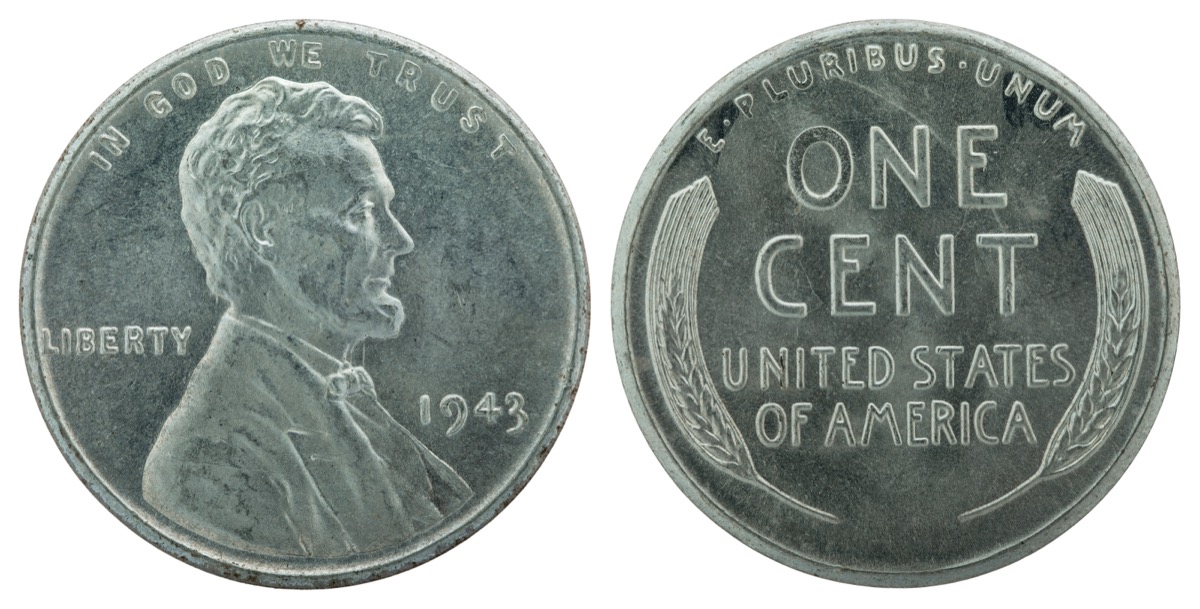

In 1943 the Mint needed its copper for the war, so the cent was struck in steel with a thin coating of zinc. The design didn't change: Lincoln on the front and two wheat stalks on the back. The new coin was magnetic and 13% lighter, at about 2.7 g. It isn't silver, even though it looks it. When new, people mistook it for a dime, and vending-machine magnets caught it as a slug.
The zinc didn't cover the cut edge, so damp and sweat made the coins rust. From 1944 to 1946 the Mint made cents from salvaged brass shell casings instead, and it later collected and destroyed many steel cents. Plenty stayed in circulation into the 1960s, and many people kept them as curiosities.
Find the mint mark
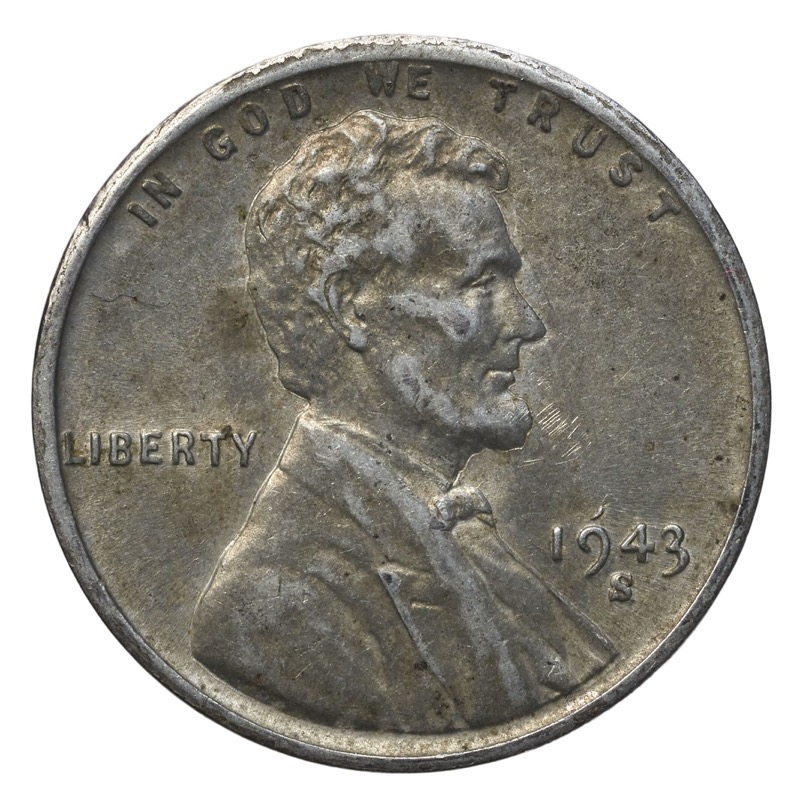

Look just below the date. A small D means Denver and an S means San Francisco. No letter means Philadelphia, which made the most.
| Coin | Mint | Struck |
|---|---|---|
| 1943 (no letter) | Philadelphia | 684,628,670 |
| 1943-D | Denver | 217,660,000 |
| 1943-S | San Francisco | 191,550,000 |
That's more than 1.09 billion coins in all. None of the three is rare in ordinary condition. The mint mark matters more for the varieties below, and for comparing prices, since a coin only compares fairly with the same mint and grade.
What a worn one is worth
If your coin has been in a jar, a drawer or a coffee can, it's almost certainly worth cents. We couldn't find a dated sale of an ordinary worn steel cent to quote. Dealers' published prices for worn ones, as COINage reported them for late 2021, were measured in cents, not dollars.
Rust, dark grey spots and a dull, blotchy surface are normal for a coin that circulated. They don't make it an error and they lower the value further. Don't clean it or try to brighten it. Cleaning leaves scratches collectors can see, and a coin that's been stripped and plated is worth less, not more.
Shiny ones: original or reprocessed?
A bright, mirror-like 1943 cent at a flea market may be a reprocessed coin, not a perfect one. Dealers stripped the old zinc from worn cents and plated them again with zinc or chrome, and these are still sold as "brilliant uncirculated". NGC, one of the two big grading services, won't grade them.
- Reprocessed: extremely reflective everywhere, even on Lincoln's face and the lettering, with a speckled or uneven look. Fine lines from the original die are gone.
- Original: a satin shine with faint lines radiating out from the centre on both sides. It isn't mirror-bright all over.
Two varieties worth checking
Use a magnifier and good light. Both are listed varieties that collectors pay for, but both need a grading service to confirm.
- 1943-D/D. The D was punched twice. Look for a second D sitting down and to the left of the main one, with a clear gap between them. It's one of the widest repunched mint marks on any coin.
- 1943/2-S. A San Francisco overdate: the 3 was punched over a 2. Look for traces of the slanting stroke of a 2 around the 3, and doubling on the 1 and 9. It was long known simply as a 1943 doubled die.
Is it a 1943 copper penny?
A few 1943 cents were struck by mistake on bronze blanks left over from 1942. They weren't discovered until 1947. An estimated 40 were struck and 27 are confirmed, so the odds that a copper-coloured 1943 in your change is one of them are tiny. Check it at home first.
- Magnet. If a magnet picks it up, it's steel. It may be a steel cent plated in copper to look valuable.
- Weight. A genuine bronze 1943 weighs about 3.11 g, and a steel one about 2.7 g. A small digital scale that reads to 0.01 g will tell them apart.
- The date. A 1945, 1948 or 1949 cent can have its last digit altered to a 3. Those pass the magnet test because they really are bronze. Genuine 1943 cents have a 3 with a long tail. Compare it with an ordinary steel 1943 under a magnifier.
A coin that passes all three still isn't proven. Non-magnetic fakes exist. Send it to PCGS or NGC, or show it to a reputable coin dealer, before you rely on it. The reverse mistake, a 1944 cent struck on a leftover steel blank, is covered in our wheat penny guide.
Rather check yours from a photo? Worthzy identifies the piece, screens it for fakes and shows a price range from matching listings, in seconds.
Get Worthzy on the App StoreWhat 1943 steel pennies sell for
These are real sales of graded coins. Grade decides almost everything. On a scale that ends at 70, the gap between MS65 and MS68 is the gap between tens of dollars and thousands.
| Coin | Grade | Sold for | When |
|---|---|---|---|
| 1943-S | MS65 | $17 | November 2021 |
| 1943-D | MS65 | Under $27 each | 2018 to 2020 |
| 1943 | MS66 | $45 | March 2020 |
| 1943-S | MS66 | $70 | 2018 |
| 1943-D | MS66 | $85 | April 2021 |
| 1943-D | MS68 | $3,100 | September 2021 |
| 1943-S | MS68+ | $19,200 | March 2021 |
| 1943 | MS68+ | $33,600 | November 2020 |
| 1943/2-S variety | MS68 | $5,760 | January 2024 |
| 1943-D/D variety | MS67 | $12,000 | November 2023 |
All of these were graded by PCGS, and the top ones were also approved by CAC. An ungraded coin, even a nice one, won't bring graded prices. Grading costs money, so it only makes sense for a coin that looks untouched under a magnifier.
Genuine 1943 bronze cents sell in a different world:
| Coin | Grade | Sold for | When |
|---|---|---|---|
| 1943 bronze | Not stated | $204,000 | January 2019 |
| 1943 bronze | MS62 Brown | $282,000 | August 2017 |
| 1943 bronze | AU50 | $298,125 | November 2022 |
| 1943-S bronze | MS63 | $504,000 | November 2020 |
| 1943-D bronze | Not stated | $840,000 | January 2021 |
The Denver coin is the only one known. It sold for $1.7 million in 2010, privately through a dealer rather than at auction.
How to check what yours would bring
Search eBay for your exact coin, for example "1943-D steel cent", and filter by Sold Items. Asking prices only show what sellers hope for. Compare like with like: a raw coin with raw coins, and a graded coin with the same grade from the same service. If you have a whole set or a jar of wheat pennies, our wheat penny value guide lists the other dates to pull out first, and what old coins are worth covers the same checks for any coin.
Sources
- 1943 Steel Lincoln Cents Worth Thousands, COINage
- Market Analysis: Repunched Mint mark on 1943 cent, Coin World
- Market Analysis: Finest 1943/2-S Lincoln cent, Coin World
- World War II era U.S. Mint mistake brings $298,125, Coin World
- Counterfeit Detection: Special Edition, Reprocessed Steel Cents, Numismatic Guaranty Company
- NGC Certifies Previously Unaccounted 1943-S Bronze Cent, Numismatic Guaranty Company
- World War II Americans disliked 1943 steel cent, Numismatic News
- Legend Sells Lincoln Cent Rarity for Record $1.7 Million, CoinNews
Related guides
Found a 1943 penny?
Photograph both sides, with the date and the space below it in focus. Worthzy identifies the coin, reads the date and mint mark where it can, and shows a value range from comparable listings. A coin that might be a copper 1943 still needs checking in person.
Get Worthzy on the App StoreWorthzy gives estimates and an authenticity screening, not a certified appraisal. For anything valuable, have a qualified specialist examine it in person.