Roseville pottery value: what it really sells for
Who made it, and when
The Roseville Pottery Company was founded in Roseville, Ohio, in 1890 and moved its headquarters to nearby Zanesville in 1898. It started with stoneware flowerpots and other household pieces. In 1900 it launched its first art line, Rozane, a name made from Roseville and Zanesville, to compete with Rookwood and Weller.
Frederick Hurten Rhead, art director from 1904 to 1909, is linked with Della Robbia, a hand-carved line. A Della Robbia vase carved with fish sold for $3,125 at Rago in June 2012. Frank Ferrell, art director from 1917, designed Blackberry, Sunflower and Pine Cone, the company's most successful pattern, made in more than 75 shapes. The last designs came out in 1953, and the Mosaic Tile Company bought the factory the next year. So a genuine piece is more than 70 years old.
Read the bottom
Roseville marked its pottery in different ways over the years, and the style of mark is the quickest way to date a piece. The references below disagree by a few years on most of these dates, so treat them as eras rather than exact years:
| What you see | Roughly when | What to know |
|---|---|---|
| "Rozane" stamped into the clay, or a small round "Rozane Ware" wafer | 1900s | The early art lines, including Della Robbia, Egypto and Mongol. |
| A blue ink "Rv", the R with a small v inside | 1910s and 1920s | Seen on Carnelian, Rosecraft and Mostique. Some early stoneware has it too. |
| Only a paper or foil label, or nothing | About 1927 to 1935 | Baneda, Blackberry, Futura, Sunflower, Falline and Cherry Blossom were marked this way. Most labels have fallen off. |
| "Roseville" in script, pressed into the clay, with a shape number and no "U.S.A." | About 1936 to 1940 | Pine Cone, Iris, Teasel and other mid-1930s lines. |
| Raised "Roseville U.S.A." with a shape number | About 1940 to 1954 | The mark most people find, on the later floral lines. |
The numbers read as shape, then size. On a piece marked 70-18, 70 is the shape and 18 is the size, usually close to the height in inches: one Peony floor vase marked 70-18 measures 18.75 inches tall. A tape measure is one of the best tools for checking Roseville, as the section on reproductions explains.
An unmarked piece can still be genuine, especially from the label years. And "Roseville" on the bottom isn't proof either: other potteries in the town of Roseville, Ohio used the name in their marks.
Patterns and their years
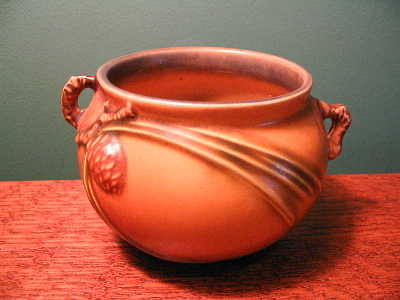

The pattern decides most of the price, so name it first. Years are when each line was introduced, mostly from the collector reference CoolOldStuff. Some lines are dated a year or two differently elsewhere, and some dealers put Pine Cone at 1935.
| Period | Lines and introduction years |
|---|---|
| Early art lines | Rozane 1900; Della Robbia, Egypto, Mara, Mongol, Olympic and Woodland 1905; Mostique 1910; Pauleo 1914; Donatello 1916; Dogwood 1918; Vista (Forest) 1920; Dahlrose 1924 |
| Middle period | Futura 1928; Poppy and Sunflower 1930; Pine Cone 1931; Moss, Primrose, Baneda and Blackberry, early 1930s; Laurel 1934; Teasel 1936; Iris 1938; Fuchsia 1939 |
| Later florals | White Rose, Cosmos, Columbine and Bittersweet 1940; Foxglove and Peony 1942; Magnolia and Water Lily 1943; Clematis 1944; Freesia 1945; Zephyr Lily and Snowberry 1946; Apple Blossom and Wincraft 1948; Artwood 1951 |
Roseville of the 1930s and 1940s was sold in mid-range department stores across America, which helps explain why so many families have a piece.
Is it a reproduction?
After the Roseville trademark lapsed, copies were made in Chinese factories and imported in large numbers, first in the early 1990s. They are sold through antique malls, shops and auctions, sometimes at the price of an original. The usual signs:
- White clay. Almost all reproductions are made of white clay and feel lighter. On many, the inside is white.
- A raised mark on the wrong pattern. Most copies carry a raised, moulded "Roseville" mark, even on patterns the factory never marked that way. Genuine Baneda, Blackberry, Sunflower and Futura had only labels, so a raised mark on one of those is a strong warning sign.
- Dull glaze and soft detail. Copy glazes are typically flat and dull, the moulding less crisp, the handles thicker and the colours off.
- The wrong size. A mould taken from a genuine piece comes out smaller each time it is copied. Measure from top to bottom and compare with a documented original of the same shape number.
- The lettering. A mark with upright letters, rather than slanting slightly to the right, deserves a closer look. A missing "U.S.A." can be a clue, but not always.
No single sign settles it. Compare with pictures of confirmed originals in a reference such as Mark Moran's Warman's Roseville Pottery, or ask a dealer who specialises in American art pottery.
Rather check yours from a photo? Worthzy identifies the piece, screens it for fakes and shows a price range from matching listings, in seconds.
Get Worthzy on the App StoreWhat Roseville sells for
These are typical eBay sold prices gathered by the price tracker Underpriced AI, on pages updated September 17, 2026. We couldn't check them against eBay directly, so treat them as a guide. The range shows the lowest and highest sale.
| Piece | Typical sold | Range | Sales |
|---|---|---|---|
| Clematis two-handled vase, brown | $39 | $19.99 to $495 | 139 |
| Florentine two-handled vase | $40 | $19.53 to $240 | 53 |
| White Rose two-handled pillow vase, green and blue | $45 | $17.50 to $350 | 102 |
| Water Lily double cornucopia vase, blue | $50 | $12 to $329.99 | 154 |
| Cosmos two-handled vase, blue | $65 | $24.99 to $500 | 71 |
| Fuchsia two-handled vase, green | $75 | $40 to $370 | 76 |
| Moss flower pot with attached saucer | $95 | $20 to $245 | 21 |
| Wisteria two-handled vase 634-7, brown | $158.75 | $58.06 to $485 | 62 |
Asking prices run well above these. The same tracker found the green Fuchsia vase listed at about $145 against the $75 it typically sold for.
At the top of the market, the specialist auction houses Rago and Toomey & Co. publish their results. A selection:
| Piece | Sale | Result |
|---|---|---|
| Futura Tank vase, model 412-9 | Rago, 20 May 2026 | $35,840 |
| Futura Flying Saucer console set | Rago, 20 May 2026 | $16,640 |
| Sunflower umbrella stand | Toomey, 17 January 2024 | $10,710 |
| Large Carnelian II vase | Toomey, 15 November 2024 | $3,528 |
| Aztec vase with Viking ships | Rago, 20 May 2026 | $2,560 |
| Baneda jardinière and pedestal | Toomey, 3 June 2025 | $1,188 |
| Mostique vases, set of five | Toomey, 22 January 2026 | $1,016 |
| Wisteria vases, set of two | Toomey, 15 November 2024 | $693 |
| Eight Cosmos pieces, sold as one lot | Toomey, 13 June 2024 | $252 |
The same Futura Tank vase model brought $25,200 at Toomey in January 2024, and a Flying Saucer console set $40,320 at the same sale, so even the rarest pieces swing widely from one sale to the next. At the other end, the lot of eight Cosmos pieces sold well under its $400 low estimate.
Prices for the later lines have come down since the 1990s revival. At a Wisconsin Pottery Association show in 1999, an eight-inch Cosmos jardinière and pedestal sold for $1,900. They are different pieces, but the gap shows how far that end of the market has moved.
What raises or lowers the price
The Wisconsin Pottery Association, a collectors' society, puts demand first, then:
- Line. Some patterns draw far more collectors than others. Pine Cone, for example, generates more interest than Florane.
- Colour. Within a line, some colours sell better. Blue Pine Cone sells for more than green, other things being equal.
- Size and form. Larger pieces usually cost more, though shape and looks matter too. The Sunflower umbrella stand above shows what an unusual large form can bring.
- Condition. Chips, cracks and hairlines lower the price. Professional restoration can bring a damaged piece back to about 50 to 90 percent of a perfect one, while amateur glue repairs usually lower it.
- Quality. Sharp moulding and strong colour matter. A factory flaw that spoils the look reduces value.
How to check what yours sells for
- Name the pattern, the colour and the shape number on the bottom, and measure the height.
- Search eBay for all three, for example "Roseville Wisteria 634-7", and filter by Sold Items. Ignore the asking prices.
- Compare the same shape, size and colour in similar condition. Check the sold photos for chips and repairs.
- For an early art piece, Futura or anything unusual, look up past results from Rago or Toomey & Co. and ask an art pottery specialist before you sell.
- Clearing a whole house? Our guide to inherited antiques covers where to start, and our guide to pottery marks helps with other makers.
Sources
- Roseville Pottery, Wikipedia
- Roseville Pottery: Identification and Early Evolution, CoolOldStuff
- Factory Marks and Labels Used by Roseville Pottery, Roseville Pottery
- Roseville Pottery Marks: Identifying Authentic Pieces, Just Art Pottery
- Factors that determine the monetary value of Roseville pottery, Wisconsin Pottery Association
- 1999 Show: Roseville, America's Decorative Art Pottery, Wisconsin Pottery Association
- Antiques & Collectibles: Roseville Pottery a colorful piece of the past, Post Bulletin
- Beware fakes when collecting Roseville pottery, Terry Kovel, via HeraldNet
- Collectible Pottery: Take a Second Look, Weekly View
- Roseville Pottery auction results, Wright (Rago and Toomey & Co. results)
- Roseville Wisteria two-handled vase 634-7 sold price guide, Underpriced AI
- Roseville Water Lily blue cornucopia vase sold price guide, Underpriced AI
- Roseville Clematis two-handled vase sold price guide, Underpriced AI
Related guides
Have a piece of Roseville?
Photograph the whole piece, the pattern up close and the bottom with its mark or numbers. Worthzy identifies the pattern and era where it can, values it from comparable listings, and says so when a photo can't settle it.
Get Worthzy on the App StoreWorthzy gives estimates and an authenticity screening, not a certified appraisal. For anything valuable, have a qualified specialist examine it in person.