McCoy pottery marks: how to identify and date McCoy
Which McCoy made it?
Three potteries in Roseville, Ohio carried the McCoy name, and their histories overlap:
- J.W. McCoy Pottery, from 1899. Most of its everyday ware was unmarked. A few art lines from 1905, such as Loy-Nel-Art and Olympia, carry a name pressed into the clay.
- Brush-McCoy, from December 1911, when George Brush took control of the J.W. McCoy pottery. It dropped "McCoy" in December 1925 and became the Brush Pottery Company. Its pieces are mostly unmarked or carry only a style number.
- Nelson McCoy, founded in April 1910 as the Nelson McCoy Sanitary Stoneware Co. and renamed the Nelson McCoy Pottery Co. in the early 1930s. It ran until the fall of 1990.
None of them is the Roseville Pottery Company, which started in the same town in 1890 and moved to Zanesville; our guide to Roseville pottery covers its marks.
When collectors and sellers say "McCoy", they nearly always mean Nelson McCoy, which made the cookie jars, planters and vases people find today. The McCoy Pottery Collectors' Society says the Brush-McCoy name appears in a permanent mark in only one published case, an ink stamp on its 1916 Vogue line. So a piece with a "McCoy" mark is almost certainly Nelson McCoy or a fake, not Brush-McCoy.
Nelson McCoy marks by period
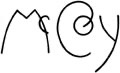

These dates come from the McCoy Pottery Collectors' Society. A mark tells you the span in which a piece was made, not the year:
| Mark | Period | What to know |
|---|---|---|
| No mark | 1910 to about 1927 | Early stoneware was left unmarked on purpose. |
| Early incised marks, or a blue ink stamp on the side | Late 1920s | The first marks. The numbers in them show size, not a date. |
| "NM" | Mid-1930s | Nelson McCoy's initials, cut into the clay. Introduced after the designer Sidney Cope joined in 1934. |
| "McCoy", "McCoy USA", "McCoy Made in USA" | Early 1940s to late 1960s | The classic mark. Earlier versions are cut into the clay; later ones are raised. |
| A mark without "McCoy" | 1967 | Mount Clemens Pottery bought the company in 1967, and its first marks left the name out. |
| "McCoy" in a new design, sometimes with "MCP" | 1968 to 1974 | Mount Clemens brought the name back in 1968. Still Nelson McCoy. |
| "McCoy" with "LCC", usually with "USA" | 1974 to 1985 | Lancaster Colony Corporation years. LCC are its initials. |
| "Nelson McCoy Ceramics", no "McCoy" name in the mark | 1985 to 1990 | Designer Accents years, until the pottery closed. |
A few other marks turn up as well:
- Floraline, a line introduced in 1960 with its own mark, later in Mount Clemens and LCC versions.
- "24K Gold" ink stamp from 1957, next to the usual McCoy mark.
- Other companies' names. McCoy made pieces under contract for CitroRamics, Esmond and Buckingham Ceramics, and those carry the customer's name.
- Ink stamps, "USA" alone, and paper labels such as "Oven Proof" or "Hand Painted".
Many real pieces have no mark
The collectors' society notes that a great number of McCoy pieces were never marked at all, in every period, and that identical pieces can be marked in three or four different ways. An unmarked planter can be genuine McCoy, and a piece marked only "USA" may be McCoy or may be from one of many other American potteries.
That gap is where sellers stretch. Unmarked and "USA" pieces are often listed as McCoy because the name sells. To identify an unmarked piece, match its shape, size, glaze and style number against the photographs in the standard McCoy reference books or the society's galleries. The shape matters more than a guess from the colour.
Fakes and look-alikes
Copies of McCoy, especially cookie jars, have been made since at least the early 1990s. The usual method is to make a mould from a genuine piece, remove the original mark from the mould and put a McCoy mark in its place. In 1992 a Tennessee maker, Roger Jensen, applied to register "McCoy" as a trademark for pottery, claiming use from 1991. The registration was cancelled in 1999, but the society says he made many of the pieces collectors object to. Pieces marked "Jensen McCoy USA" came after the pottery closed, so they are not Nelson McCoy.
Some fakes copy real McCoy jars. Others are designs McCoy never made, with a McCoy mark added. The society lists jars in that second group, including:
- Little Red Riding Hood, Snow White, Cinderella and Goldilocks
- Daisy Cow and Elsie Cow
- Mugsie, Whistler and Clown
- Cobalt Rooster and Jadite Rooster
- Wilber Pig, White Bear, Rocking Horse and Elephant with Ice Cream
- Donald Duck Turnabout
Its rule of thumb: if a piece is marked "McCoy" but appears in none of the McCoy reference books, it is probably a fake.
How to check a suspect piece
- Measure it. Clay shrinks as it dries and fires, so a copy cast from a genuine piece comes out smaller. The society treats a piece that is 6 percent or more smaller in height or length than a documented original as most probably a copy. Genuine pieces vary slightly, so a few millimetres alone prove little.
- Weigh it. Copies are usually lighter than the original.
- Look at the clay and the base. Compare the clay colour, the thickness of the walls, and whether the bottom is glazed, and how far, with a known example.
- Compare the glaze and paint. Check the glaze colour and the shade and quality of any cold paint, the unfired paint used on many cookie jars.
- Don't rely on the mark alone. A copy moulded from a genuine piece can carry a faint version of the genuine mark, and a fake can carry a McCoy mark it never earned.
Size works in one direction only. Some imported look-alikes, such as certain frog planters, are larger than the originals and unmarked, so a piece that isn't smaller isn't automatically genuine.
What affects value
- The model. The highest McCoy prices are for cookie jars. Common planters and vases, made in large numbers, usually sell for much less.
- Authenticity. A jar on the reproduction or fake lists needs proof, such as exact measurements, before buyers will pay full price.
- Condition. Chips, cracks, hairlines and repairs all lower the price. On cookie jars, worn cold paint counts too.
- Completeness. A cookie jar is worth far less without its original lid.
- Colour. The same shape can sell differently in different glazes, so compare like with like.
Rather check yours from a photo? Worthzy identifies the piece, screens it for fakes and shows a price range from matching listings, in seconds.
Get Worthzy on the App StoreWhat McCoy sells for
Most McCoy sells for modest sums, and the spread between pieces is wide. Cookie jars sit at the top. Citing WorthPoint, an antiques price database, Tasting Table reported that collectors paid between $699 and $1,200 for select McCoy cookie jars in 2025. Those are the better jars, not the typical one. Your own piece's model, colour and condition decide where it falls, which is why the sold listings for the exact same piece matter more than any general figure.
Be careful with headline prices for rare jars. Many are repeated from article to article without a named sale behind them, and asking prices on marketplaces are often far above what pieces sell for.
How to check what yours sells for
- Identify the model and colour, and note the mark and any style number on the bottom.
- Search eBay for "McCoy" with the model or style number and filter by Sold Items. Asking prices tell you little.
- Compare like with like: the same model, size and colour, a lid with a lid, and similar condition.
- Look out for listings of known fakes and copies among the sold results, which can drag an average down or push it up.
- For a jar you think is rare, measure it against a documented original before you sell, and ask a dealer who specialises in American pottery.
Sources
- Trademarks, McCoy Pottery Collectors' Society
- Trademarks: Additional History, McCoy Pottery Collectors' Society
- A Quick Guide to the Detection of Nelson McCoy Fakes & Reproductions, McCoy Pottery Collectors' Society
- About McCoy Fakes and Look-Alikes, McCoy Pottery Collectors' Society
- If Your Grandma Collected Cookie Jars, Take A Closer Look, Tasting Table
Related guides
Not sure your McCoy is real?
Photograph the piece and a close-up of the bottom. Worthzy identifies the maker and era where it can, values it from comparable listings, and says so when a photo can't settle it.
Get Worthzy on the App StoreWorthzy gives estimates and an authenticity screening, not a certified appraisal. For anything valuable, have a qualified specialist examine it in person.