Hummel figurines value: what yours really sell for
Why most Hummels sell for modest sums
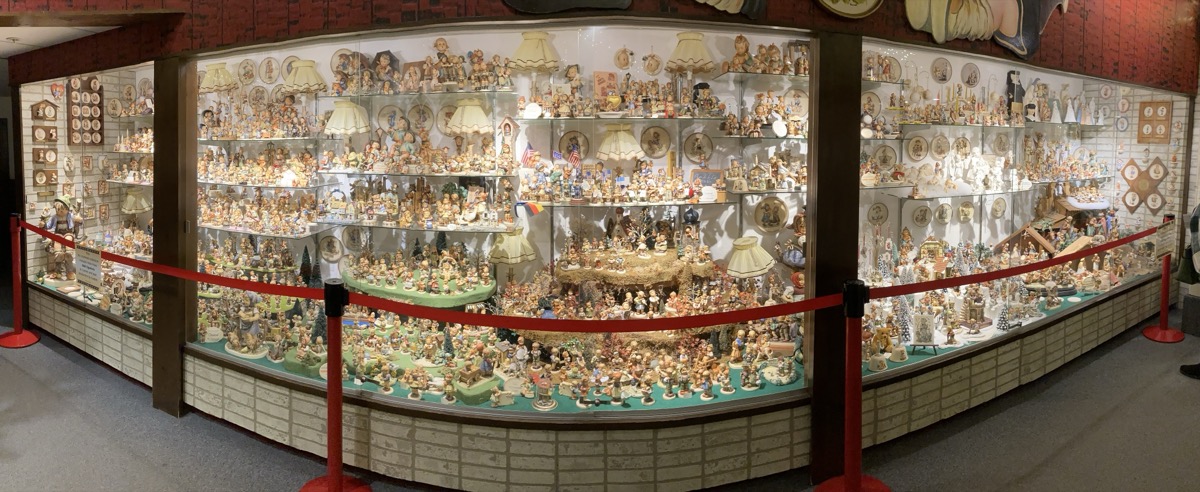

Hummel figurines are porcelain children based on the drawings of Berta Hummel, who became Sister Maria Innocentia at the Franciscan convent of Siessen in 1931. Franz Goebel saw her art on postcards in a Munich shop, the convent gave his company the sole right to turn it into figurines, and the first ones were shown at the Leipzig Trade Fair in 1935. By the end of that year 46 designs were on sale, including in America at Marshall Field & Co.
They became an American favourite after the Second World War, when soldiers stationed in West Germany sent them home and the Army PX stores sold them. Speculators drove prices up in the 1970s. Goebel kept making them until 30 September 2008, and they are still made in the same town, Rödental, today.
That long production run is why most Hummels are worth modest sums now. Goebel made them for more than seventy years, a great many were bought as gifts and souvenirs, and the generation that collected them is now selling. A figurine that cost a lot new is often worth far less second-hand.
Check that it is a real Hummel
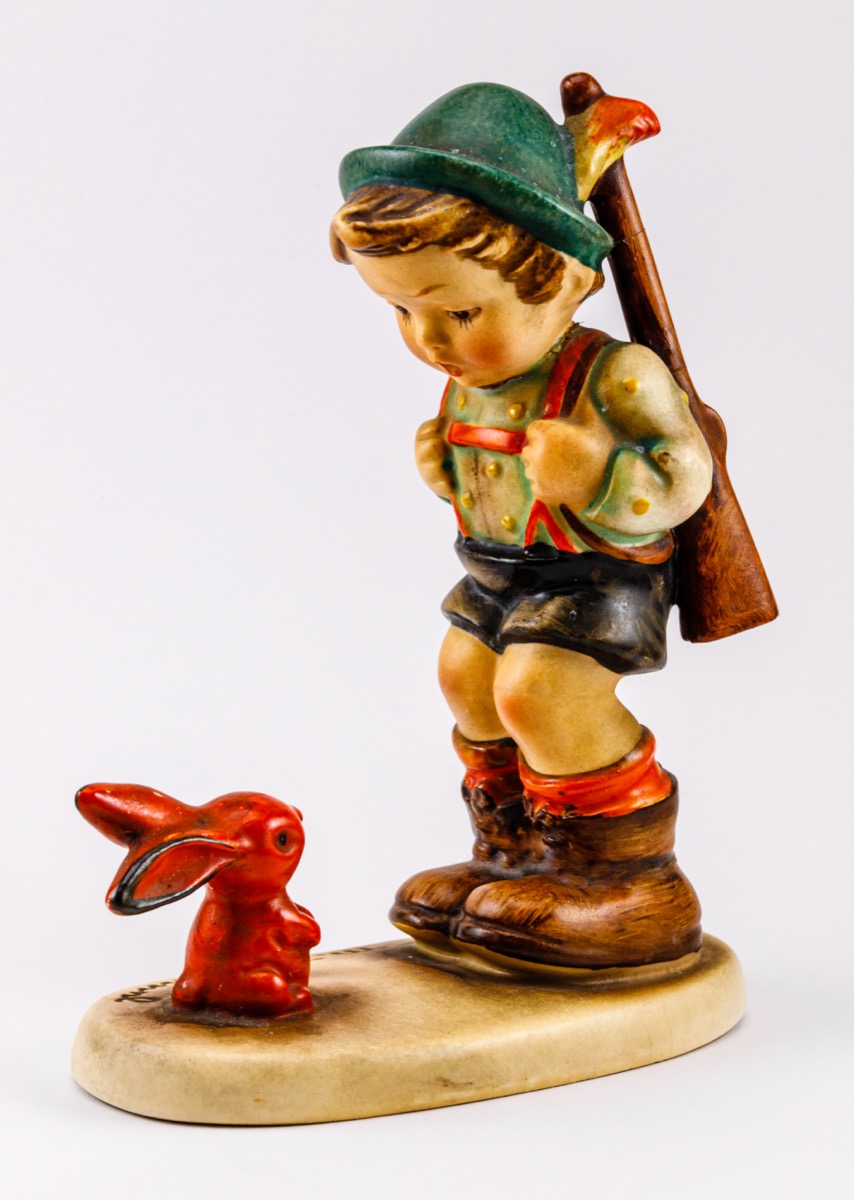

Turn it over. A genuine Goebel Hummel has three things:
- The signature "M.I. Hummel", incised into the base.
- A mold number (the "Hum" number) on the underside, such as 1 for Puppy Love or 64 for Shepherd's Boy. A number after a slash gives the size: the giant Apple Tree Boy is marked 142/X.
- A trademark: a crown, a bee, or the Goebel name.
Many figurines of rosy-cheeked children were made "in the style of" Hummel by other companies. Without the signature and a Goebel trademark, it isn't a Hummel. Reproductions can also feel lighter in the hand than real porcelain.
Read the trademark to date it
The trademark is the single most useful mark on a Hummel. Goebel changed it every decade or so, and collectors number the marks TMK-1 to TMK-9. This chart follows Heidi Ann Von Recklinghausen, author of The Official M.I. Hummel Price Guide. She points out that the early dates are approximate, probably to within about five years, and that pieces are known from outside the stated years.
| Mark | What it looks like | Roughly when |
|---|---|---|
| TMK-1, Crown | A crown over the letters WG (William Goebel), sometimes incised in a circle. Two crowns, one incised and one stamped, is the "Double Crown". | 1935 to about 1950 |
| U.S. Zone | "U.S. Zone" or similar wording beside the other marks, often over the glaze and easily worn off. | 1946 to 1948 |
| TMK-2, Full Bee | A large bumblebee flying inside a V. From about 1956 the bee is smaller and sits lower in the V. | About 1950 to 1959 |
| TMK-3, Stylized Bee | A simplified, flat bee in the V, with "W. Germany" beside or below it. | About 1960 to 1972 |
| TMK-4, Three Line | The stylized bee and V with three lines of wording beside it, in blue. | 1964 to 1972 |
| TMK-5, Last Bee | The last mark with the V and bee. Under the glaze until 1976, over it after. | 1972 to 1979 |
| TMK-6, Missing Bee | No bee and no V. The artist's mark now includes the date the piece was painted. | 1979 to 1991 |
| TMK-7, Hummel Mark | "Germany" with no "West", in a mark used only on Hummel pieces. | 1991 to 1999 |
| TMK-8, Millennium Bee | A bee on its own again, without the V. | 2000 to 2008 |
| TMK-9, Manufaktur Rödental | A yellow-and-black bee circling "Original M.I. Hummel Germany". | 2009 onward |
The bee is a tribute to Hummel herself: it came from a childhood nickname meaning bumblebee. You may also see "First Issue" (from 1990, a new figure's first year), "Final Issue" (from 1991, its last year) or a 1996 backstamp for Goebel's 125th anniversary.
Older marks usually mean higher prices for the same figure, but they are not a guarantee of a big number, as the sales below show.
Rather check yours from a photo? Worthzy identifies the piece, screens it for fakes and shows a price range from matching listings, in seconds.
Get Worthzy on the App StoreWhat Hummel figurines sell for
These are sold prices, not asking prices. The eBay sales are listed by Underpriced AI, a price-tracking app, from completed listings in September and October 2026; the auction results are from Invaluable's archive. They show the spread you can expect.
| Figurine | Mark | Sold for | Where and when |
|---|---|---|---|
| Puppy Love, Hum 1, 5" | TMK-5 | $10.80 | eBay, October 2026 |
| Puppy Love, Hum 1 | Not stated | $54 | eBay, October 2026 |
| Playmates, 58/0 | TMK-2 Full Bee | $10 | eBay, October 2026 |
| Boy with Toothache, 217 | TMK-2 Full Bee | $13.49 | eBay, October 2026 |
| Shepherd's Boy, 64 | TMK-2 Full Bee | $36 | eBay, October 2026 |
| Book Worm, 14/A | TMK-2 Full Bee | $64.80 | eBay, October 2026 |
| Favorite Pet, 361 | TMK-4 | $13.50 to $20 (three sales) | eBay, October 2026 |
| Harmony in Four Parts, 471 | Not stated | $150 | Hill Auction Gallery, May 2020 |
| Adventure Bound, 347, large | TMK-5 | $600 | Blackwell Auctions, January 2021 |
| Czech Boy holding lamb (International series) | Not stated | $1,600 | Blackwell Auctions, January 2021 |
| Apple Tree Girl, jumbo 32" | Not stated | $2,200 | Blackwell Auctions, January 2021 |
| Apple Tree Boy, jumbo 30" | Not stated | $2,500 | Blackwell Auctions, January 2021 |
| Hungarian Boy with dog (International series) | Not stated | $3,000 | Blackwell Auctions, January 2021 |
| Swedish Girl with letter (International series) | Not stated | $3,500 | Blackwell Auctions, January 2021 |
| Signs of Spring, described as rare | Not stated | $5,500 | Blackwell Auctions, January 2021 |
Across 52 recent eBay sales of Puppy Love, the middle half sold for $12 to $25. For Favorite Pet, 30 sales put the middle half at $13 to $29. Small Apple Tree Girl and Boy figures, 141/1 and 141/2, sold as a pair for $80 at Smith Auction Company in July 2021, against $2,200 and $2,500 for the jumbo sizes. A lot of 31 Hummel plates and plaques sold for $50 in total at Gray's Auctioneers in February 2020.
We couldn't find dated, checkable individual sales for Crown Mark pieces, so we haven't put a number on them. If yours has a crown, look up the same mold number and mark in sold listings before you sell.
What raises or lowers the price
- Which figure. The mold number matters more than anything else. Multi-figure groups, the International series (national costumes, mold numbers in the 800s and 900s) and the giant sizes sell for far more than single small children.
- Size. The same figure was often made in several sizes, and the larger ones usually sell for more.
- Trademark. Crown and early bee marks are preferred over later ones for the same figure.
- Condition. Chips, cracks, glued repairs, missing paint and heavy crazing all cut the price. Check fingers, hat brims and the tips of anything sticking out, where damage hides.
- Box and papers. An original Goebel box adds to the price.
How to check what yours sells for
- Write down the name, the mold number including anything after the slash, the trademark and the height.
- On eBay, search for "Hummel" with the mold number and mark, such as Hummel 64 full bee, then tap Filter and turn on Sold items. Compare only pieces with the same number, size and mark, in similar condition.
- For a jumbo size, an International figure or a Crown Mark piece, check auction archives such as Invaluable or LiveAuctioneers, or ask an auction house that sells figurines.
- Selling a whole collection? With common pieces selling for $10 to $25, posting them one by one may not be worth it; they can do better as a group at a local auction or estate sale. Our guide to inherited antiques covers where to start.
For marks on other figurines and china, see how to identify pottery and porcelain marks. For Royal Doulton figures, see how to date and value them by HN number.
Sources
- How To Identify Hummel Trademarks, Antique Trader
- Hummel Figurines: Price List, History and Rare Examples, Invaluable
- Hummel figurines, Wikipedia
- Maria Innocentia Hummel, Wikipedia
- Goebel Hummel Puppy Love (Hum 1) sold price guide, Underpriced AI
- Goebel Hummel Boy with Toothache (217) sold price guide, Underpriced AI
- Goebel Hummel Favorite Pet (361) sold price guide, Underpriced AI
Related guides
Have a shelf of Hummels?
Photograph each figurine from the front and the underside with its marks. Worthzy identifies the figure and its trademark where it can, values it from comparable listings, and says so when a photo can't settle it.
Get Worthzy on the App StoreWorthzy gives estimates and an authenticity screening, not a certified appraisal. For anything valuable, have a qualified specialist examine it in person.