Griswold vs Wagner: how to tell them apart and which is worth more
Read the bottom first
Both makers cast their name into the underside, so turn the pan over in good light. These are the quickest ways to tell them apart:
| What to look for | Griswold | Wagner |
|---|---|---|
| Where it was made | Erie, Pennsylvania: ERIE, or ERIE, PA, U.S.A. | Sidney, Ohio: SIDNEY, O. or SIDNEY -O- |
| The logo | A cross inside a double circle with GRISWOLD across it | WAGNER in plain letters, straight or arched, or WAGNER WARE with one large fancy W |
| Where the logo sits | The cross logo sits in the centre | Usually near one edge, at what collectors call 12 o'clock; some pans made between 1924 and 1935 have it in the centre |
| The number on a No. 8 skillet | Pattern number 704, often with a letter | Catalog number 1058, often with a letter |
| Economy and other lines | Victor, marked THE GRISWOLD MFG. CO. | National, Long Life and Wardway |
A pan marked only ERIE, with no cross, is an early Griswold. Some old Wagner pans show a faint "ghost" of the ERIE mark, because Wagner made some early patterns from Erie pans. A pan with both names on it was made after the two companies came under one owner in 1957.
Griswold marks and their dates
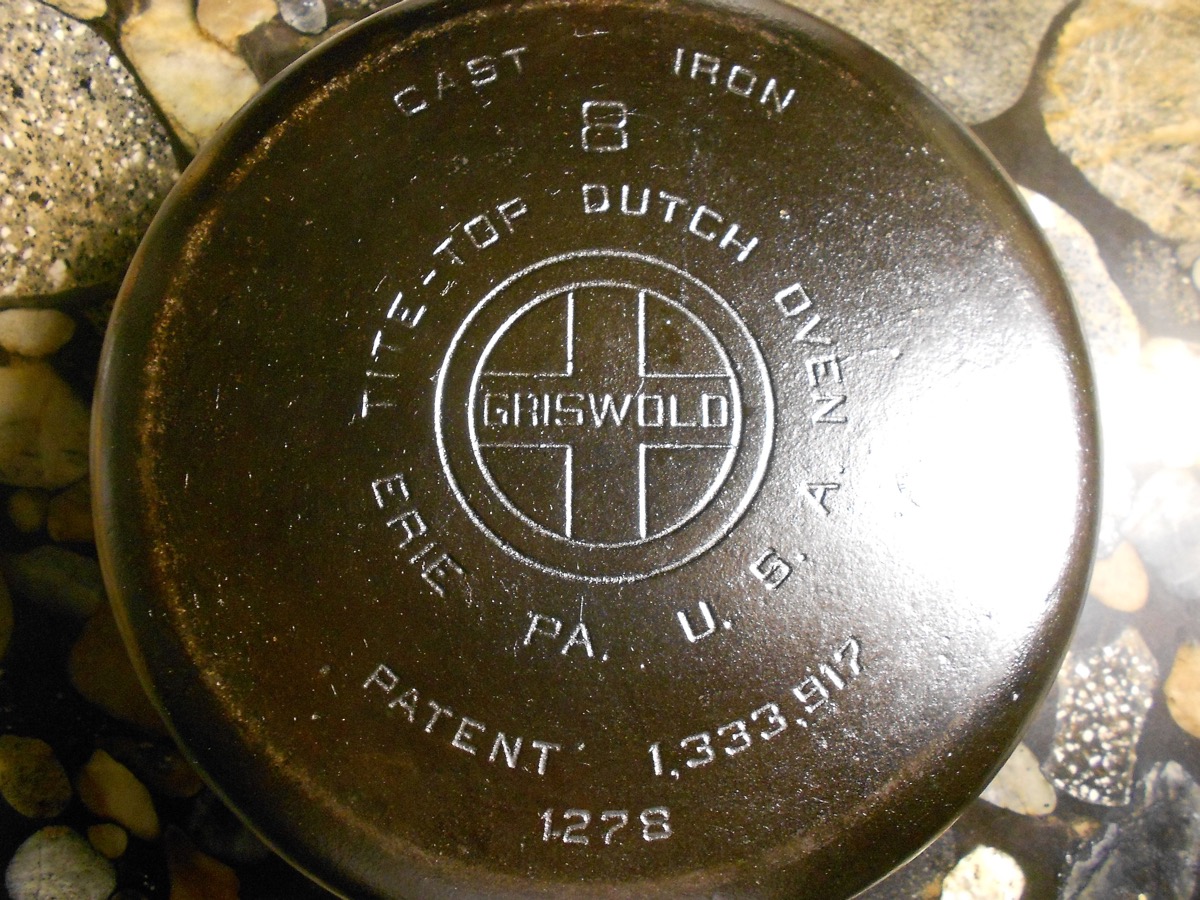

Griswold began in Erie in the 1860s and made cast iron there until the plant closed in December 1957. Its logo changed every few decades, so it dates the pan:
| Mark | What it looks like | Roughly when |
|---|---|---|
| ERIE | The word ERIE, no cross | Before about 1906 |
| GRISWOLD'S ERIE | The words, no cross | About 1905 to 1909 |
| Slant logo | Cross in a double circle, GRISWOLD in slanted letters; "slant Erie" or "slant EPU" (ERIE, PA, U.S.A.) | About 1906 to the 1920s |
| Large block logo | Bold upright GRISWOLD, ERIE, PA, U.S.A., often CAST IRON SKILLET | About 1920 to 1940 |
| Small block logo | A much smaller, lighter cross with ERIE, PA. | About 1939 to 1957 |
| Griswold logo without ERIE, or beside a Wagner logo | Made from Wagner patterns after the sale | 1957 to the late 1960s or early 1970s |
Small block skillets have no heat ring, the raised ring on the base, except sizes 12 and up; most earlier ones do. The Cast Iron Collector, a long-running reference site, says collectors care less for small block pans, though the quality is almost the same.
Wagner marks and their dates
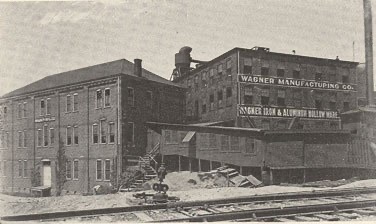

Wagner was incorporated in Sidney, Ohio, in 1891, and made aluminum cookware too, from 1894, including Magnalite from the early 1930s. The collectible iron pans are the ones marked SIDNEY:
| Mark | What it looks like | Roughly when |
|---|---|---|
| WAGNER | Plain block letters, straight or in an arc, later with SIDNEY, O. below | 1890s to about 1920 |
| WAGNER WARE SIDNEY O. | The word WARE added between WAGNER and SIDNEY | From about 1914, into the 1920s |
| Stylized logo | One large fancy W for WAGNER WARE, with SIDNEY and -O- beneath | About 1922 to 1959 |
| Pie logo | The stylized logo in a wedge-shaped border, CAST IRON SKILLET curved at the bottom | About ten years, in the 1920s or 1930s |
| WAGNER WARE without SIDNEY -O- | The stylized logo alone | After 1959 |
| Wagner with a General Housewares logo, markings turned upside down compared with older pans | Later production | After 1969 |
Collectors treat 1959, when SIDNEY -O- was dropped, as the end of collectible Wagner.
Why the dates don't agree
These years are collectors' estimates, worked out from old catalogues and pans that can be dated, and the main references disagree:
- Slant logo: 1906 to 1929 in the Cast Iron Collector's trademark table, 1909 to 1929 in its skillet table, and the 1910s to the early 1920s on Wikipedia.
- Large block logo: from about 1920 on the Cast Iron Collector's trademark page, from 1924 in its skillet table, and the 1920s and 1930s on Wikipedia.
- Small block logo: from about 1939 at the Cast Iron Collector, from the early 1940s on Wikipedia.
- End of the Griswold name: after 1973 at the Cast Iron Collector; the Wikipedia article says the late 1960s in one section and the early 1970s in another.
- Wagner pie logo: the Cast Iron Collector's table says 1924 to 1934, but the same page says it appeared shortly after Wagner's smooth-bottom skillets, which it dates elsewhere to about 1935.
So treat a logo as a window of years, not a date. The slant logo also carried on for some years after the large block logo arrived.
After 1957: one owner, both names
Griswold's family sold the company in 1946. In 1957 McGraw-Edison bought it and sold the Griswold brand to Wagner, owned by the Randall company since 1952. Textron bought both in 1959 and General Housewares in 1969. Production moved to Wagner's foundry in Sidney, and the Cast Iron Collector notes that later Griswold-marked pans look like modified Wagner patterns. A Griswold logo with no ERIE, one with no cross, or Griswold and Wagner logos on one pan all date from after 1957.
New pans exist too. Wagner Cast Iron, a new company, has made reissues of vintage Wagner designs since 2022. Collectible vintage Wagner, made up to 1959, says SIDNEY on the bottom, apart from the earliest pans marked only WAGNER.
Which pieces collectors pay most for
- Rare sizes. The very small and very large skillets: Griswold Nos. 1, 2, 13, 14 and 20, and Wagner Nos. 2, 13 and 14, sold for hundreds to thousands of dollars in the sales below.
- Early Griswold marks. ERIE and slant-logo pans, especially in rare sizes.
- Large block Griswold. The best-known Griswold mark, and "perhaps the most attractive to collectors" in the Cast Iron Collector's words.
- Wagner pie logo. Among the most collectible Wagners. A pie logo No. 2 and a No. 5 each sold for $1,000 or more.
- Odd variants. Slant-logo smooth-bottom Griswolds, and Wagner shallow skillets with a three-hole handle: one Wagner No. 8 shallow skillet sold for $400, against $20 to $115 for the 11 ordinary marked Wagner No. 8s in the same records.
Condition comes before all of these. The Cast Iron Collector says a hairline crack "drastically" reduces collector value, and warping, rust or sulphur pitting and fire damage all lower it too, whatever the mark.
Rather check yours from a photo? Worthzy identifies the piece, screens it for fakes and shows a price range from matching listings, in seconds.
Get Worthzy on the App StoreWhat each sells for
These are real sold prices. The No. 8 comparison counts every matching single skillet in GriswoldCookware.com's database of collector auctions from November 2025 to October 2026, at Dinky's Auction Center in Indiana and Tennessee and Simmons & Company in Missouri. Prices are hammer prices; online buyers also paid a 15% premium. We couldn't check each lot on the auction house's own page.
| No. 8 skillet | Lots sold | Sold for |
|---|---|---|
| Griswold, slant logo (ERIE or EPU) | 10 | $85 to $135 |
| Griswold, large block logo | 17 | $85 to $220 (middle $105) |
| Griswold, small logo | 5 | $35 to $80 |
| Wagner or National Wagner, not pie logo | 11 | $20 to $115 |
| Wagner pie logo | 1 | $200 |
Online, a common Wagner Ware Sidney -O- No. 8 (1058) sold for a typical $44.98 across 44 recent sales, the middle half between $36 and $53, according to Underpriced AI, a tracker of eBay sold results, on a page updated November 2, 2026.
At the top end, the gap between the makers is wider:
| Pan | Where and when | Sold for |
|---|---|---|
| Griswold No. 1 skillet, slant logo ERIE, heat ring | Air Works, Ohio, Feb 2025 | $9,750 |
| Griswold No. 14 bailed skillet | Dinky's, Indiana, Oct 30, 2026 | $4,000 |
| Griswold ERIE "spider" No. 8, pitted | Air Works, Feb 2025 | $4,000 |
| Griswold No. 13 large block, heat ring | Air Works, Feb 2025 | $3,300 |
| Griswold No. 13 slant EPU | Dinky's, Tennessee, Jun 12, 2026 | $2,600 |
| Griswold No. 2 large block, heat ring | Dinky's, Nov 13, 2025 | $2,000 |
| Griswold No. 20 hotel skillet, large block | Air Works, Feb 2025 | $1,550 |
| Wagner No. 2 pie logo | Dinky's, Nov 13, 2025 | $1,100 |
| Wagner No. 5 pie logo | Dinky's, Tennessee, Jun 13, 2026 | $1,000 |
| Wagner No. 13 pie logo, heat ring | Air Works, Feb 2025 | $1,000 |
| Wagner No. 14 pie logo, heat ring | Air Works, Feb 2025 | $550 |
| Wagner No. 14 pie logo | Simmons, Missouri, Oct 31, 2026 | $450 |
The Air Works prices, as reported by GriswoldCookware.com, leave out a 20% online or 7.5% on-site buyer's premium. These are among the best results of their sales, not what a typical pan of that size fetches.
How to check yours
- Read everything on the bottom: maker, logo style, the size number and the pattern or catalog number, and whether there is a heat ring.
- Set it on a hard, level surface and press the rim: a pan that rocks is warped. Then look at the sides in strong light for a fine line that runs over the rim, the usual sign of a hairline crack.
- Search eBay for the maker, size, logo and number, for example "Griswold 8 704 large block" or "Wagner Ware Sidney 8 1058", and tick Sold Items. Compare only pans with the same mark, heat ring and condition.
- For a rare size, an early mark or a pie logo, search a collector auction database such as GriswoldCookware.com's, which lists the sale date for every price.
For Lodge, unmarked pans and the damage that lowers value, see our guide to cast iron skillet value.
Sources
- Evolution of the Griswold Trademark, The Cast Iron Collector
- Evolution of the Griswold Skillet, The Cast Iron Collector
- Evolution of the Wagner Trademark, The Cast Iron Collector
- Damage & Defects, The Cast Iron Collector
- Griswold Manufacturing, Wikipedia
- Wagner Manufacturing Company, Wikipedia
- Griswold Prices & More: Search Cast Iron Auction Results, GriswoldCookware.com
- Top Auction Prices Realized at Air Works Consignment Auction February 2025, GriswoldCookware.com
- Wagner Ware Sidney -O- No. 8 Cast Iron Skillet 1058 sold price guide, Underpriced AI
Related guides
Have a Griswold or Wagner pan?
Photograph the whole bottom straight on, so the logo, size and pattern number are readable, plus the cooking surface and the handle. Worthzy reads the marks, values the pan from comparable sales, and says so when a photo can't settle it, such as a hairline crack or a slight warp.
Get Worthzy on the App StoreWorthzy gives estimates and an authenticity screening, not a certified appraisal. For anything valuable, have a qualified specialist examine it in person.