Fiestaware value: what vintage Fiesta really sells for
Why Fiesta is collected
Fiesta is the solid-colour dinnerware made by the Homer Laughlin China Company of Newell, West Virginia, which renamed itself the Fiesta Tableware Company in 2020. Frederick Hurten Rhead designed it, and it was introduced at the Pottery and Glass Exhibit in Pittsburgh in January 1936. It was cheap and cheerful, sold piece by piece so buyers could mix colours, at stores such as Woolworth's and Kresge.
The original run lasted until January 1973. Homer Laughlin brought Fiesta back in 1986 for its 50th anniversary, and it is still made today. That matters for value: "Fiesta" covers both the vintage pieces collectors chase and decades of newer dinnerware, some of it in colours with the same names as the old ones.
Is it vintage or new Fiesta?
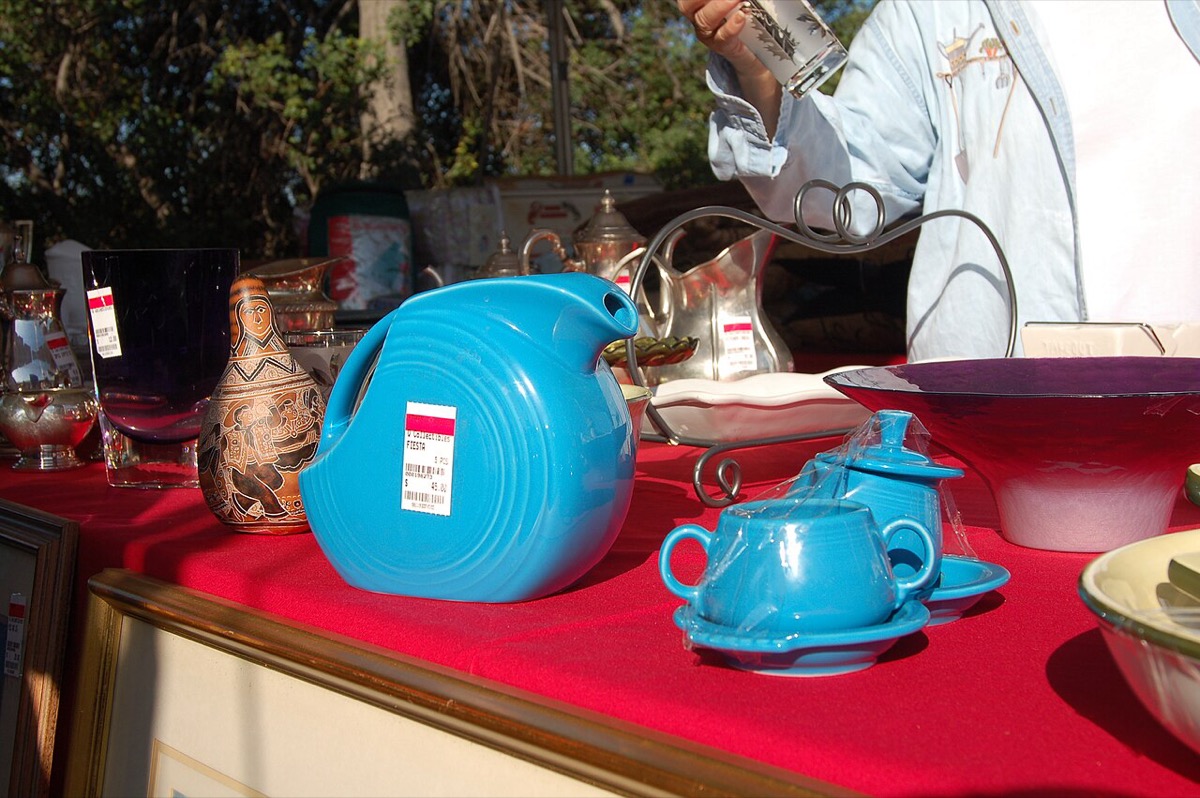

Collectors count pieces made from 1936 to the early 1970s as vintage. Turn the piece over and check these together, because no single clue settles it:
- The mark. A vintage mark spells "fiesta" in lowercase, often with "HLCo USA" and sometimes "GENUINE" above it. "FIESTA" in capitals, a mark set in a circle, or a letter H in the logo points to 1986 or later. Since the 1990s many new marks also carry a few extra letters that code the year.
- How it is marked. Plates get an ink stamp under the glaze; mugs, bowls, pitchers and vases have the mark pressed into the mold. Some old molds were reused after 1986, so a pressed lowercase mark is weaker evidence than a stamped one.
- No mark at all. The company says it is not unusual to find a Fiesta plate without a stamp, especially vintage ones made before 1973. A missing mark doesn't make a piece new or fake.
- Glaze and size. Vintage glaze is soft and semi-opaque, more like eggshell than glass. Post-1986 Fiesta is made from a harder, fully vitrified clay, so it is glossier, and the same shapes come out noticeably smaller.
- Colour. None of the newer colours exactly matches any of the vintage ones, and the chart below shows which colours only existed before 1973.
Vintage Fiesta colours and years
Sources differ by a year on some of these dates, and we give both where they disagree.
| Colour | What it looks like | Made |
|---|---|---|
| Red | Bright orange-red | 1936 to 1943 or 1944, then 1959 to 1972 |
| Yellow | Deep golden yellow | 1936 to 1969 |
| Cobalt blue | Strong blue, lighter than the modern Cobalt | 1936 to 1950 or 1951 |
| Light green | Soft mid green | 1936 to 1950 or 1951 |
| Old Ivory | Yellowish cream | 1936 to 1950 or 1951 |
| Turquoise | Robin's-egg blue, less green than today's Turquoise | 1937 or 1938 to 1969 |
| Rose | Dark brownish pink | 1950 or 1951 to 1959 |
| Gray | Medium gray | 1950 or 1951 to 1959 |
| Forest green | Dark green | 1950 or 1951 to 1959 |
| Chartreuse | Bright yellowish green | 1950 or 1951 to 1959 |
| Medium green | Bright, almost Kelly green | 1959 to 1969 |
| Mango Red, Turf Green, Antique Gold | The restyled "Fiesta Ironstone" line; Mango Red is the same red renamed | 1969 to 1973 |
Medium green was made only in the 1960s, when sales were low, so there is much less of it about, and certain medium green pieces sell for far more than the same shape in other colours. Red usually carries a premium too. The late 1960s Amberstone (brown) and Casualstone (Antique Gold with a pattern) lines used Fiesta shapes under other names.
Newer colours with old names, such as Rose (1986), Turquoise (1988) and Chartreuse (1997), are different glazes from the vintage ones. A few post-1986 colours had very short runs, among them Lilac (1993 to 1995), Sapphire (sold only at Bloomingdale's, 1996 to 1997), Chartreuse (1997 to 1999) and Juniper (2000 to 2001).
Red Fiesta and uranium
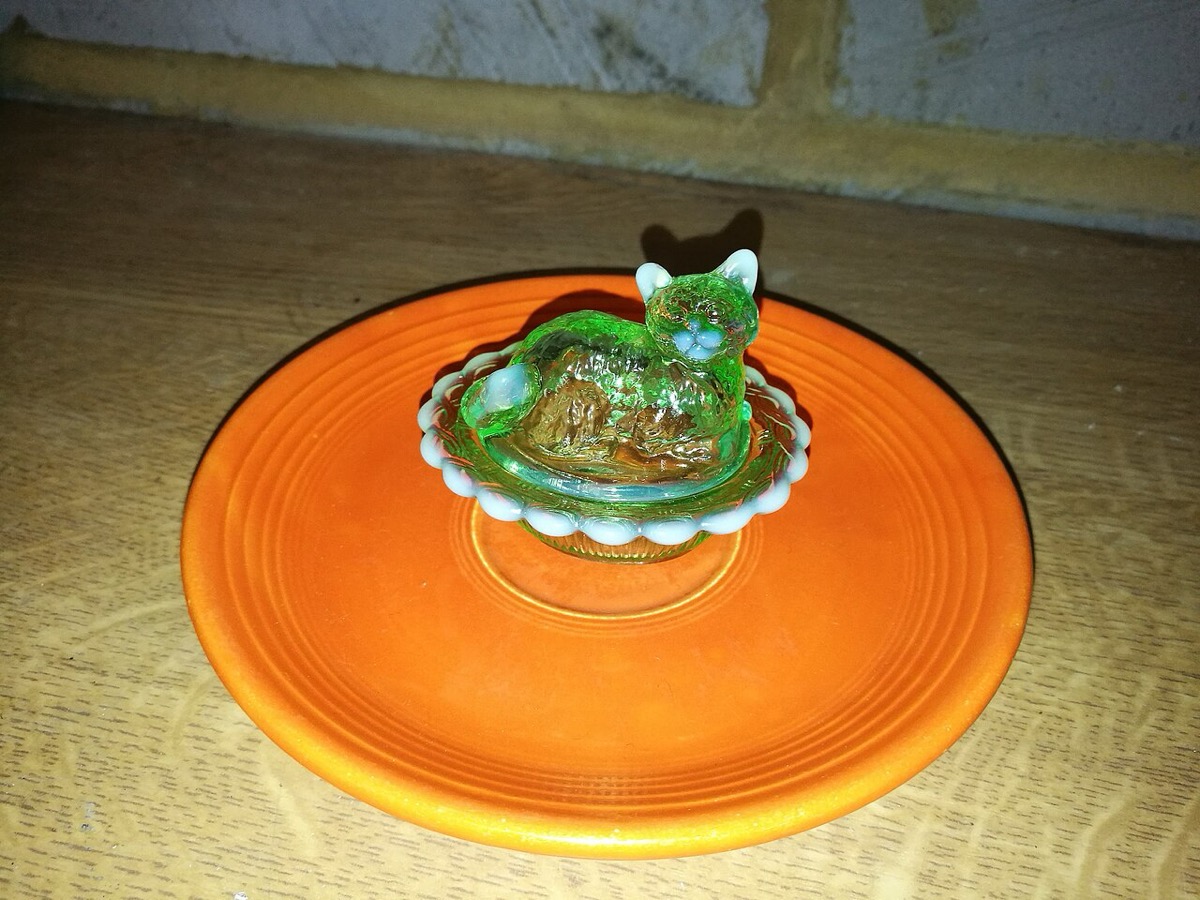

The orange-red glaze was coloured with uranium oxide. The Museum of Radiation and Radioactivity at Oak Ridge reports that up to 14% of the glaze by weight might be uranium. During the Second World War the government took the company's uranium stocks, so red disappeared until 1959, when it came back made with depleted uranium. It ended with Fiesta Ironstone in 1973, and the 1986 Fiesta was relaunched without it. Other vintage colours, ivory among them, also contain some uranium, but the museum measured its red far above its ivory.
The US Environmental Protection Agency says radioactive antiques are usually not a health risk while they are intact, but advises not to use ceramics like antique orange-red Fiestaware for food or drink, because they can chip. Display it rather than eat from it. Red was also the most expensive colour when new, because of the cost of its materials and the care needed in firing, and it remains the colour collectors want most.
Rather check yours from a photo? Worthzy identifies the piece, screens it for fakes and shows a price range from matching listings, in seconds.
Get Worthzy on the App StoreWhat Fiestaware sells for
These are sold prices, not asking prices. The eBay sales come from completed listings tracked by Underpriced AI, a price-tracking app, and the item descriptions are the sellers' own. The auction results are from Strawser Auctions in Indiana, which holds dedicated Fiesta sales, as reported by Antiques and The Arts Weekly and Auction Daily; they include the buyer's premium.
| Piece | Sold for | Where and when |
|---|---|---|
| Disc water pitcher, vintage green, sold as is | $17 | eBay, September 2026 |
| Disc water pitcher, vintage turquoise | $32.99 | eBay, September 2026 |
| Disc water pitcher, vintage chartreuse | $45 | eBay, September 2026 |
| Carafe, original red, no lid, three chips | $18.75 | eBay, July 2026 |
| Carafe, vintage red-orange | $55 | eBay, July 2026 |
| Carafe, vintage cobalt, with lid | $58 | eBay, July 2026 |
| Footed salad bowl, turquoise | $89.95 | eBay, June 2026 |
| Footed salad bowl, ivory | $125 | eBay, May 2026 |
| Footed salad bowl, green | $195 | eBay, May 2026 |
| Footed salad bowl, red | $210 and $285 (two sales) | eBay, May and June 2026 |
| 12-inch vases, yellow to cobalt | $825 to $990 | Strawser, September 2004 |
| Maroon cup and saucer (not a catalogue colour) | $2,232 | Strawser, March 2024 |
| Turquoise individual creamer, one of a few known | $4,960 | Strawser, March 2024 |
| Maroon two-pint jug, one of two known | $11,160 | Strawser, March 2024 |
| Ivory covered onion soup bowl with red stripes | $12,075 | Strawser, March 2016 |
| Ivory experimental individual teapot, about three known | $20,075 | Strawser, September 2004 |
Across 35 recent sales of the footed salad bowl, the median was $46.99, while sellers were asking a median of $129.37. Expect the same gap with most Fiesta: asking prices run well ahead of what pieces sell for.
Newer Fiesta in a retired colour usually sells for less than vintage. Luncheon plates in Claret, a colour made from 2016 to 2018, sold for a median of $22.50 across 48 sales in 2026, with single plates going for $9.99 and $13.99.
We couldn't find dated, checkable sales of single vintage dinner plates or cups, so we haven't put a number on them. They are the most common pieces of all; look them up as described below.
What raises or lowers the price
- Shape. Serving pieces and scarce shapes sell for far more than place settings. Covered onion soup bowls and mixing bowl lids were dropped by 1938 and are rare; vases, carafes, teapots and the footed salad bowl are wanted.
- Colour. Red, medium green and the colours made for shorter runs bring more than yellow or turquoise, which were made for decades. Colours that were never in the catalogue, like maroon, are probably prototypes or test pieces and bring the highest prices of all.
- Vintage or new. The same shape and colour name from after 1986 is a different, more common piece.
- Condition. Chips, cracks and worn glaze cut the price hard, as the chipped carafe above shows. Check rims, feet, spouts and the edges of lids.
- Lids and parts. A carafe, teapot or casserole without its lid or stopper is worth much less than a complete one.
How to check what yours sells for
- Work out the shape, the colour and whether it is vintage, using the mark, the glaze and the colour chart above.
- On eBay, search for the shape and colour, such as vintage Fiesta turquoise carafe, then tap Filter and turn on Sold items. Compare only pieces of the same era, size and condition, and check the photos: sellers mix up vintage and new.
- For a rare shape, an odd colour or a piece with stripes, look up Strawser Auctions' past Fiesta sales on LiveAuctioneers, or ask an auction house that handles it.
- Selling a cupboard full? Common place settings often do better sold as a set or a mixed lot than one plate at a time. Our guide to pricing items for an estate sale covers how.
For other kitchen collectibles, see our guides to vintage Pyrex and Depression glass, and for marks on other pottery, how to identify pottery and porcelain marks.
Sources
- Fiesta (dinnerware), Wikipedia
- Fiestaware (ca. 1930s), ORAU Museum of Radiation and Radioactivity
- Radioactivity in Antiques, US Environmental Protection Agency
- FAQ: Dinnerware, Fiesta Factory Direct
- Fiesta Ware Saucer, 1936-1955, The Henry Ford
- How To Identify Fiesta Backstamps, Hunker
- Fiesta history timeline, Post86 Reference Guide
- Strawser's Fiestaware Auction: White Glove Sale Hits $182,000, Antiques and The Arts Weekly
- Indiana Auction Yields $20,075 Fiesta Teapot, Antiques and The Arts Weekly
- Strawser Auction Group's Two Day March 2024 Fiestaware Auction, Auction Daily
- Vintage Fiesta footed salad bowl sold price guide, Underpriced AI
- Fiesta carafe sold price guide, Underpriced AI
- Fiesta disc water pitcher sold price guide, Underpriced AI
- Fiesta Claret luncheon plate sold price guide, Underpriced AI
Related guides
Found a stack of Fiesta?
Photograph each piece from the top and the underside with its mark. Worthzy identifies the shape and colour where it can, says whether it looks vintage or newer, and values it from comparable listings.
Get Worthzy on the App StoreWorthzy gives estimates and an authenticity screening, not a certified appraisal. For anything valuable, have a qualified specialist examine it in person.