Ball mason jar value: how to date a Ball jar by its logo
Date a Ball jar by its logo
Ball never dated its jars, but it changed the way it wrote its name often until about 1962, so the logo is the best clue to age. The two usual references are a chart from Minnetrista, the Ball family's heritage centre in Muncie, Indiana, and Dick Roller's dates in the Standard Fruit Jar Reference, which the Bottle Research Group checked against the company's history in 2022. Where they disagree, both are shown.
| What the logo looks like | Minnetrista | Roller |
|---|---|---|
| Intertwined letters BBGMC (Ball Brothers Glass Manufacturing Company), on jars made in Buffalo, New York | About 1885 to 1886 | 1885 to 1886 |
| No Ball name at all | Not listed | About 1888 to 1895 |
| BALL in block capitals | About 1895 to 1896 | 1895 to 1896 |
| First script Ball, written level with an underline | About 1895 to 1896 | 1895 to 1896 |
| "Triple L": slanted script, a curl at the top of the B, an "a" with a downstroke, and an underline that starts with a loop, so it reads like a third l | About 1900 to 1910 | About 1896 to 1910 |
| The loop becomes a plain underline; the dropped "a" stays | 1910 to 1923 | 1910 to 1923 |
| No underline and no dropped "a" | 1923 to 1933 | 1923 to 1933 |
| The underline returns, still no dropped "a" | 1933 to 1962 | 1933 to 1960 |
| The B is drawn without the small curl in its middle (Minnetrista: the bottom loop of the B is closed) | 1960 on | 1960 on |
Minnetrista starts the triple-L in 1900; Roller, and the collector site Glass Bottle Marks, about 1896. Minnetrista ends the underlined logo in 1962, Roller in 1960. For the Buffalo monogram jars, Minnetrista's own article says they were first made in 1884, Glass Bottle Marks gives 1884 to 1886, and Julian Toulouse's 1969 book Fruit Jars says only 1886 and 1887. Treat every range as approximate. A small registered-trademark ® beside the logo means after about 1975.
The rim is a second clue. Mouth-blown jars had their rims ground flat on a grinding wheel after blowing, which leaves a rough, matte edge; jars were finished this way until about the early 1910s. Every jar with the block-letter or first script logo has a ground rim. Machine-made jars have a smooth rim.
The 1858 date is not your jar's age
Many old jars carry "Mason's Patent Nov 30th 1858". That is the date John L. Mason was granted his patent for a jar with a screw thread and a shoulder that seals against a rubber ring, not the date your jar was made. Mason's patents ran out in the 1870s and 1880s, and scores of glassworks then used the same wording until about 1915. Ball didn't make glass at all until about 1884; its Buffalo works made 1858 jars between 1886 and 1888, sealed with glass inserts marked "Ball Bros. Glass Mfg. Co.".
So many were made that an 1858 jar is usually not rare. At a Valley Auctions sale in March 2022, plain aqua and blue quarts with the 1858 wording sold for $10 each.
What the number on the bottom means
The large number on the base of most Ball jars (0 to 15 on Ball Perfect Masons) is a mould number. A jar machine held eight to ten moulds making the same jar, and the number told inspectors which mould was producing faulty jars. Minnetrista says plainly that it has nothing to do with when the jar was made. Some value guides claim a 13 makes a jar worth more; at a November 2020 auction, five blue Ball jars, all numbered 13, sold together for $65.
Colours: aqua, Ball blue, clear and the odd ones
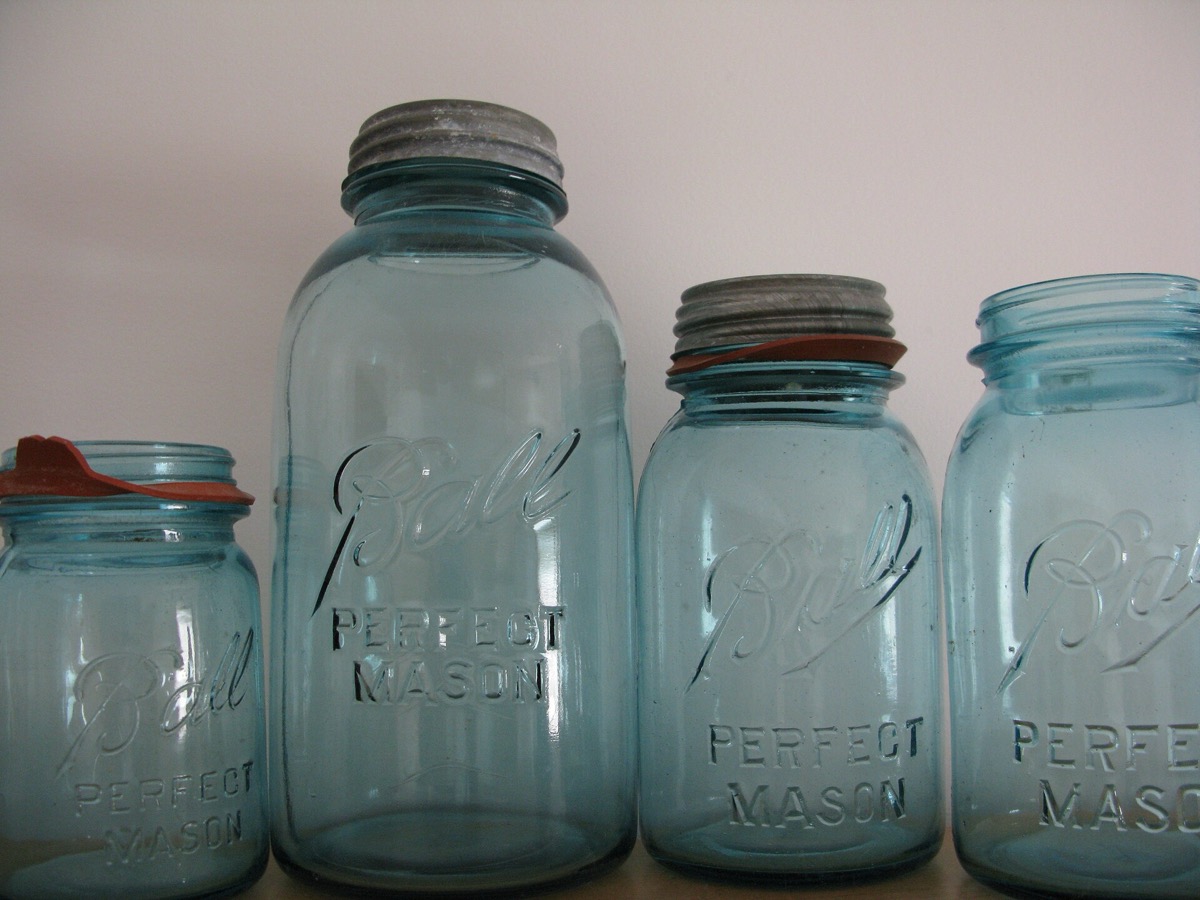

- Aqua and green. The earliest jars are pale aqua or green. Edmund Ball said these shades came naturally from the ingredients and were not controlled.
- Ball blue. From about 1910 a deeper blue-aqua replaced the old aqua. Collectors call it Ball blue, and almost no other maker's glass is that colour. Clear jars became more common from the mid-1910s, and the last Ball blue jars were made about 1937.
- Clear. Most jars from the late 1930s on are clear glass.
- Olive, amber swirls and other odd colours. Some batches came out olive green or streaked with amber. These are the colours collectors pay for, as the prices below show.
- Modern blue jars. In 2013 Jarden Home Brands, then the maker of Ball home canning jars, sold blue Heritage Collection pint jars with a period-correct logo to mark the 100th anniversary of the Perfect Mason. They carry anniversary embossing. A blue Ball jar is not automatically old.
The lids and closures that matter
- Zinc screw cap with a white liner. The classic Mason lid. The liner is milk glass, though it has long been called "porcelain"; the earliest were clear glass. Zinc caps were made until the Second World War, when the zinc shortage moved makers to tin-plate bands.
- Glass lid and wire bail. The Ball Ideal used a wire clamp that holds a glass lid down, a "Lightning" type of closure patented in 1908 and made until at least the 1960s. Ball's first wire-bail jar dates from about 1898.
- Two-piece lid. A flat metal lid with a sealing compound under a screw band, adapted by Alexander Kerr in 1915 and still used today. It tells you little about age.
- Wax sealers. The Ball Standard had a groove around the mouth that was sealed with hot wax under a metal cap. It was discontinued in 1912.
A lid that belongs to the jar adds to its value. Specialist auction listings say when a lid is the "correct" one for the jar, and Roller's reference dates Ball's glass and metal lid inserts too.
What is common and what is rare
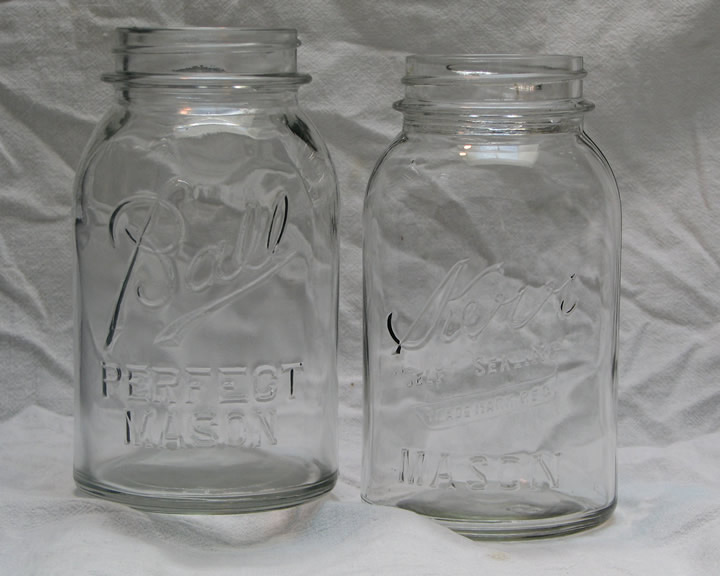

Common. The Ball Perfect Mason, which Ball says it introduced in 1913, was made in enormous numbers in Ball blue and then clear. A 1934 Ball advertisement claimed that more than three-quarters of all jars in use were Ball jars.
Scarce.
- Buffalo jars with the BBGMC monogram, mouth-blown in green and aqua. Minnetrista calls them "pretty rare". Block-letter and first script jars from the mid-1890s are early too.
- Error jars, such as a triple-L jar with the logo embossed upside down, or the Ball Mason with a backwards S that sold for $45 in 2020.
- Altered jars. Ball bought other glassworks and re-cut their moulds, so some jars show another maker's name changed to Ball, among them Port, Root, Boyd, Drey and Pine.
- Unusual colours, as the prices below show.
Reproduced. In 1976 amber copies of the Buffalo jar were mouth-blown at the Indiana Glass Company, embossed "An Historic Reproduction Muncie, Indiana 1976 No. 1 The Amber Buffalo Jar". A 1982 monogram jar made for the Ball Guest House is also a commemorative, not a Buffalo original.
Rather check yours from a photo? Worthzy identifies the piece, screens it for fakes and shows a price range from matching listings, in seconds.
Get Worthzy on the App StoreWhat Ball jars sell for
These are hammer prices published by the auction houses, before the buyer's premium. Ordinary blue and clear jars mostly sell in lots, not one by one.
| Jars | Sold for | Where and when |
|---|---|---|
| Nine blue Ball Perfect Mason jars, 5½ to 9½ inches | $30 for the lot | Ace Auctions, March 2025 |
| Blue Ball mason jars with glass and zinc lids | $35 for the lot | Atlee Raber Auctions, March 2025 |
| Ten Ball blue jars, two Ball jelly jars and two other pieces, some chipped | $15 for the lot | Valley Auctions, September 2024 |
| Lots of 14, 15 and 24 Ball blue quarts, some with lids | $10, $15 and $30 a lot | Valley Auctions, November 2020 |
| Five Ball blue jars, all mould number 13 | $65 for the five | Valley Auctions, November 2020 |
| Eleven half-pint Ball Ideal jars, aqua and clear | $55 for the lot | Valley Auctions, November 2020 |
| Ball Perfect Mason half gallon, green, chips on the lip | $10 | Valley Auctions, November 2020 |
| Triple-L Ball quart, aqua | $15 | Valley Auctions, November 2020 |
| Ball Mason's Patent 1858, ground rim | $10 | Valley Auctions, November 2020 |
| 1976 amber Buffalo reproduction with paperwork | $40 | Valley Auctions, November 2020 |
Colour, closure and odd variants are what lift a single jar:
| Jar | Sold for | Where and when |
|---|---|---|
| Ball Sure Seal 22 oz, marked for a maple products company | $75; another with a damaged lip, $45 | Valley Auctions, November 2020 |
| ABGA Mason Perfect quart, Ball blue, with its correct lid and band | $75 | Valley Auctions, November 2020 |
| Ball Perfect Mason quart, light olive green | $50 | D. Owen Grove Auctions, September 2017 |
| Ball Perfect Mason quart, green with amber swirls, chips on the lip | $70 | Valley Auctions, November 2020 |
| Ball Perfect Mason half gallon, light green with amber streaks | $100 | D. Owen Grove Auctions, September 2017 |
| Ball Mason quart, olive green with amber swirls, small chip | $150 | Valley Auctions, November 2020 |
| Ball Standard wax sealer quart, olive green with amber swirls | $160 | Valley Auctions, November 2020 |
The highest Ball prices we could verify come from an older sale, at Old Barn Auction in October 2007: a half-pint Ball Perfection in Ball blue sold for $600, a pint "The Ball, Pat. Appl. For" with a tin lid for $500, an aqua Ball Bros. Glass Mfg. Co. quart described as porcelain lined for $400, a half-gallon Ball Standard in olive green with amber swirl for $400, and a half-gallon Ball Improved in amethyst for $200. A clear Ball Perfect Mason pint in the same sale made $5.
We found no dated, verifiable sale of an original Buffalo monogram jar, so we don't quote one; the price ranges on value websites name no sale.
How to check yours
- Match the logo to the table: is there an underline, a dropped "a", a curl in the B? Ignore the 1858 and the number on the base.
- Run a finger round the rim. Rough and ground means mouth-blown and probably before the 1910s; smooth means machine-made.
- Judge the colour in daylight against white paper, and note the lid, chips, cracks and haze inside.
- Write down every word embossed on the jar, and its size. Specialist listings often add a Red Book number ("RB#") from Douglas Leybourne's price guide The Collector's Guide to Old Fruit Jars.
- On eBay, search the exact embossing and colour, such as Ball Perfect Mason olive quart, then tap Filter and turn on Sold items. Compare the same size, colour and condition.
- For a Buffalo jar, an early logo, an error or an unusual colour, ask a fruit jar club before selling. The Midwest Antique Fruit Jar and Bottle Club meets at Minnetrista in Muncie.
If you have other coloured kitchen glass from the same years, see our guide to identifying Depression glass. For jadeite and other Anchor Hocking pieces, see Fire-King value.
Sources
- How to Date a Ball Jar, Minnetrista
- Ball Brothers Glass Mfg. Co. (Lockhart, Schriever, Serr and Lindsey), Society for Historical Archaeology, Historic Bottle Website
- Food Bottles & Canning Jars, Society for Historical Archaeology, Historic Glass Bottle Identification & Information Website
- Ball Brothers Glass Manufacturing Company, Glass Bottle Marks
- Jarden Home Brands Releases Limited-Edition, Blue Vintage-Inspired Ball Brand American Heritage Collection Mason Jars, PR Newswire
- Absolute Fruit Jar Collection Auction, November 14, 2020 (Valley Auctions), LiveAuctioneers
- Online Only Absolute Estate Auction, March 19, 2022 (Valley Auctions), LiveAuctioneers
- Fine Collection of Early Fruit Jars, September 30, 2017 (D. Owen Grove Auctions), LiveAuctioneers
- Antique Bottles & Jar Auction, October 19, 2007 (Old Barn Auction), LiveAuctioneers
- Nine Blue Glass Ball Perfect Mason Jars (Ace Auctions, March 2025), LiveAuctioneers
- 1910-1975 Blue Ball Mason Jars (Atlee Raber Auctions, March 2025), LiveAuctioneers
- Ball Mason Jars (Valley Auctions, September 2024), LiveAuctioneers
Related guides
Not sure which Ball jar you have?
Photograph the jar from the front with the logo in focus, its base and its lid. Worthzy reads the embossing where it can, values the jar from comparable listings, and says so when a photo can't settle which version it is.
Get Worthzy on the App StoreWorthzy gives estimates and an authenticity screening, not a certified appraisal. For anything valuable, have a qualified specialist examine it in person.