Fire-King value: what your dishes really sell for
What Fire-King is
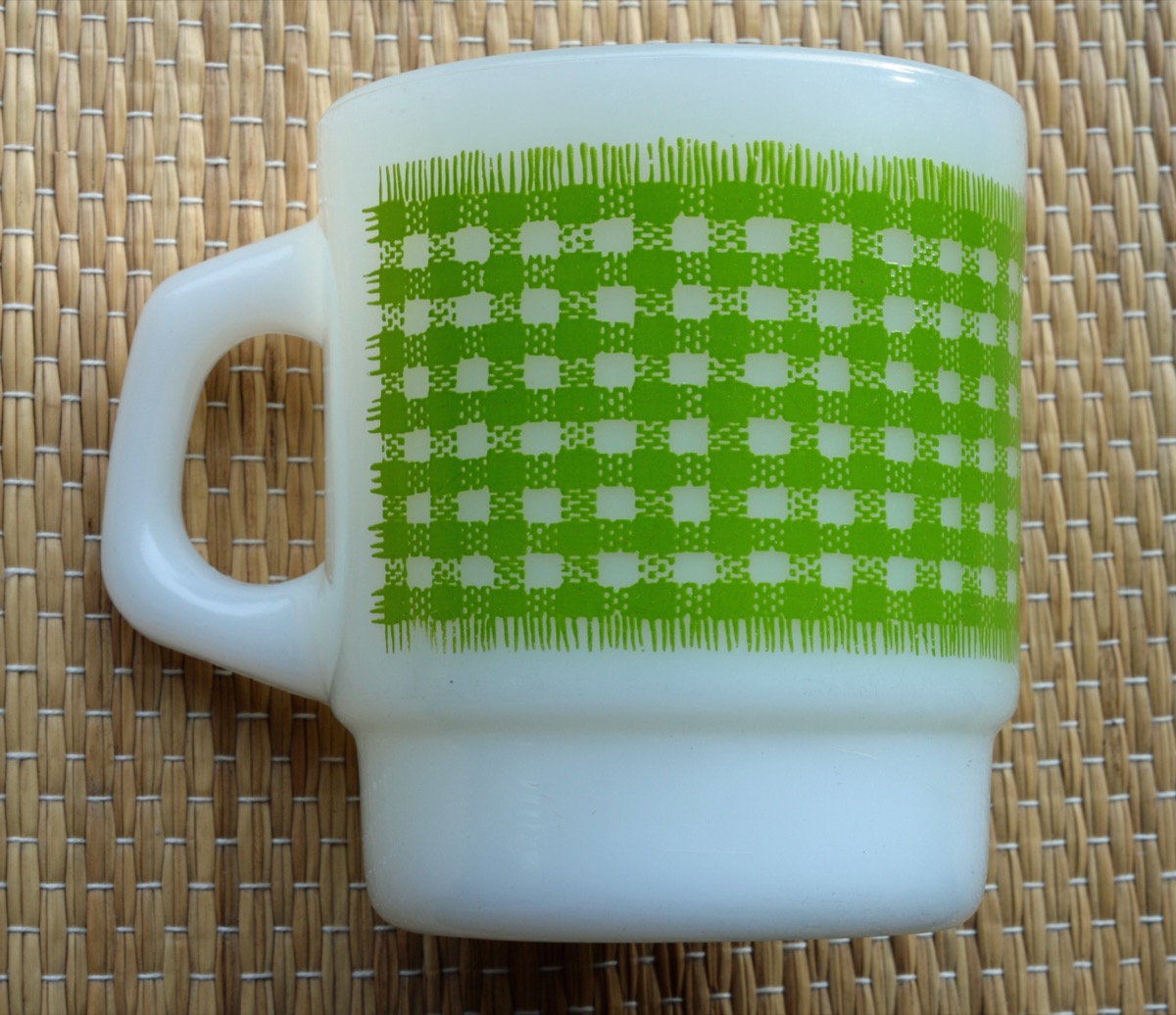

Fire-King was the oven-safe glass of Anchor Hocking, the glassworks in Lancaster, Ohio. The first pieces were made in 1942, in a pale transparent blue with a pressed scroll pattern, as ovenware that could replace metal pans. Jade-ite, the opaque jade-green glass most people mean when they say Fire-King, followed in 1945. Ivory, white, the light blue Azur-ite, the iridescent Peach Lustre and many decorated white patterns came later. Original production ended in 1976.
It was cheap and everywhere. Fire-King was sold in grocery, hardware and five-and-dime stores and given away as a premium with flour and oatmeal. The thick Restaurant Ware sold 25 million pieces in its first six years, and a 1950 Anchor Hocking advert called it the lowest-priced tableware service on the market. That is why so much survives, and why most of it is worth modest sums today.
Collecting took off in the 1990s, when Martha Stewart showed her Jade-ite on television and in her magazine. Prices jumped, and so did the reproductions.
Read the mark on the bottom
Most Fire-King has its mark moulded into the glass underneath. Anchor Hocking changed the wording several times, so the mark is the quickest way to date a piece. These dates come from the collector site FireKing Grill, which bases them on Wilkins' 1991 collector's guide to Fire-King. Treat them as approximate:
| What the mark says | Roughly when |
|---|---|
| "FIRE-KING" alone, in capitals, or no mark | Early 1940s, on the first pale blue ovenware |
| All block capitals: "OVEN FIRE-KING GLASS", "OVEN FIRE-KING WARE" or "FIRE-KING OVEN GLASS" | About 1945 to 1948 |
| "Fire-King" in script, with "OVEN" and "GLASS" or "WARE", and nothing else | About 1948 to 1950 |
| The script mark plus "MADE IN U.S.A.", often with numbers | From 1951 |
| The Anchor Hocking anchor-and-H logo added to the Fire-King mark | From 1962 |
| Anchor Hocking with "HEAT RESISTANT" and no Fire-King name | Later 1960s and 1970s |
| "Fire-King 2000", or a sticker saying "Made in Brazil" | The 2000 reissue, not vintage |
A rule of thumb from the same source: the more words in the mark, the newer the piece. The numbers that appeared from 1951 identify the piece and the mould, and the dots around the mark mean nothing. Don't trust a listing that calls a "MADE IN U.S.A." piece 1940s.
No mark doesn't mean not Fire-King. Some early ovenware, some promotional and special-order pieces, and patterns such as Alice and Charm were often unmarked or carried only a paper or foil label that has since come off. Two marks get mistaken for Anchor Hocking's: Hazel-Atlas used an H with an A beneath it, and Federal Glass an F inside a shield.
Jade-ite patterns and how scarce they are
The pattern decides most of the price, so name it first. Years are approximate and vary a little between references.
| Pattern | How to recognise it | Years | How easy to find |
|---|---|---|---|
| Restaurant Ware | Plain and heavy, about twice as thick as the home patterns; later plates have a beaded rim | 1948 to the 1970s | Common; the longest-running line |
| Jane Ray | Ribbed rays around the border, plain centre | Mid-1940s to early 1960s | The most common Jade-ite pattern |
| Alice | Small notched edge and a floral border; given away in oatmeal boxes | 1945 to about 1949 | Often unmarked |
| Charm | The only square Jade-ite pattern | 1950s, for four to six years | Short run, priced higher |
| Swirl and Shell | Swirl has a smooth edge; Shell has a scalloped edge you can feel | Shell from the 1960s | Swirl dinnerware seldom comes up |
| Sheaves of Wheat | Wheat stalks around plate borders and outside the bowls and cups | 1957 to 1959 | Two-year run, hard to find |
| Philbe | Embossed floral design on ovenware and refrigerator dishes | From 1942 | Early and scarce in every colour |
Among single pieces, the Restaurant Ware ball jug, a round pitcher, is the one collectors most want. It is hard to find with the spout and handle undamaged, and it has been reproduced.
Vintage, reissue or reproduction?
Jade-ite has been copied more than any other Fire-King colour. The usual suspects:
- Anchor Hocking's own 2000 reissue. New moulds, Jade-ite only, made in Brazil. The mark reads "Fire-King 2000" and new pieces carried a Made in Brazil barcode sticker. It included swirl mixing bowls, a batter bowl, a pie plate, a covered casserole and 8 by 8 and 9 by 13 inch baking dishes; the 9 by 13 dish was never made originally. These pieces have their own collectors but are not vintage.
- Martha by Mail and other makers. In the late 1990s Martha Stewart's catalogue sold jadeite made largely by Mosser Glass and L.E. Smith. Mosser, Tablecraft and others have made jadeite since.
- Other old green glass. McKee and Jeannette made jadeite in the 1930s, before Fire-King, and are collected in their own right. A green piece without a Fire-King mark may be one of theirs: see how to tell Fire-King, Jeannette and McKee jadeite apart. Theirs was coloured with uranium and glows under a black light, while Fire-King doesn't; our guide on how to tell if glass is uranium glass explains the test.
Check the mark, the shape against documented pieces, and the weight. FireKing Grill weighed five Restaurant Ware 7 oz coffee mugs at 321 to 338 grams and an extra-heavy mug at 437 grams, so a kitchen scale is a useful tool.
Rather check yours from a photo? Worthzy identifies the piece, screens it for fakes and shows a price range from matching listings, in seconds.
Get Worthzy on the App StoreWhat Fire-King sells for
These are individual eBay sales listed by the price tracker Underpriced AI on pages updated between July and October 2026. We couldn't check them against eBay directly, so treat them as a guide.
| What sold | Sold | Price |
|---|---|---|
| Milk glass custard cup, 6 oz | Oct 26, 2026 | $6.26 |
| White milk glass gravy boat | Oct 26, 2026 | $6.74 |
| Jane Ray Jade-ite 9" plates, set of 2 | Sep 18, 2026 | $24.95 |
| Rooster pattern 1 qt baking dish | Oct 27, 2026 | $26.96 |
| Jane Ray Jade-ite cereal bowls, set of 2 | Sep 17, 2026 | $26.97 |
| Jane Ray Jade-ite cream jug and sugar bowl with lid | Sep 17, 2026 | $39 |
| Tulip milk glass mixing bowl, 8.5" | Jun 21, 2026 | $42.95 |
| Jane Ray Jade-ite dinner plates, set of 3 | Sep 18, 2026 | $44.99 |
| Jade-ite Swirl mixing bowl, 6" | Oct 27, 2026 | $45 |
| Tulip milk glass mixing bowls, 7.5" and 8.5" | Jun 27, 2026 | $69.99 |
| Tulips salt and pepper shakers with original lids | Oct 26, 2026 | $82.99 |
| Jane Ray Jade-ite cups and saucers, set of 8 | Sep 16, 2026 | $107.97 |
| Jane Ray Jade-ite dessert bowls, set of 13 | Sep 17, 2026 | $107.97 |
Notice how little a single common piece brings: the set of eight Jane Ray cups and saucers works out at under fifteen dollars a pair. The same tracker put the typical sale of a Harvest Amber 1 qt casserole at $20.25, with half of its 49 sales between $12 and $36.
We left out the four-figure prices that circulate for rare colours and the ball jug, because we couldn't find a dated sale behind them. If you have one of the scarce patterns or shapes above, look up its own sold results before you price it.
What raises or lowers the price
- Pattern and colour. Charm, Sheaves of Wheat, Philbe and early pale blue are scarce. Jane Ray, Restaurant Ware and plain white are common.
- Shape. Some shapes were made in far smaller numbers. In Restaurant Ware, FireKing Grill lists the ball jug, the 8-inch lunch plate, the flanged soup bowl, the gravy boat and the large handled soup cup among the hard-to-find pieces.
- Condition. Chips and cracks on rims, spouts and handles are what collectors look for first. On Peach Lustre and decorated white, a worn or dishwasher-faded finish lowers the price.
- Age. FireKing Grill notes that the earliest block-letter Jade-ite has more collector value than later pieces. Within the same pattern, an earlier mark helps.
- Sets. Sets sell readily, but often for little per piece, as the table above shows.
How to check what yours sells for
- Name the colour, the pattern and the shape, read the mark and measure the piece.
- Search eBay for those words, for example "Fire-King Jane Ray Jade-ite dinner plate", and filter by Sold Items. Ignore asking prices.
- Compare pieces with the same mark and in the same condition, and check the sold photos for chips.
- If the bottom says 2000 or the sticker says Brazil, compare with other 2000 pieces, not vintage ones.
- Old Fire-King may not be as oven-proof as it once was. The Glass Encyclopedia advises caution about using it in the microwave, so don't test a valuable piece in one.
- Have Pyrex or CorningWare too? See our guides to vintage Pyrex and CorningWare. For pink and green transparent glass, see Depression glass.
Sources
- Fire-King Ovenware, National Depression Glass Association (Glass Review, 1981)
- How to Identify Fire-King Jadeite Dish Markings, FireKing Grill
- How to Identify Fire-King Jadeite Dish Patterns, FireKing Grill
- Restaurant Ware Jadeite Dishes: Fire-King Pattern Identification Guide, FireKing Grill
- 2000 Jadeite Dishes: Learn How to Identify this Fire-King Pattern, FireKing Grill
- The History of Jadeite Dishes, FireKing Grill
- Fire-King Glass, Glass Encyclopedia
- Fire-King, Wikipedia
- Fire-King Jane Ray Jadeite sold price guide, Underpriced AI
- Anchor Hocking Fire-King Harvest Amber 1 qt casserole sold price guide, Underpriced AI
- Fire-King Tulips milk glass mixing bowl sold price guide, Underpriced AI
Related guides
Have some Fire-King?
Photograph the whole piece, the pattern up close and the mark on the bottom. Worthzy identifies the line and era where it can, values it from comparable listings, and says so when a photo can't settle it.
Get Worthzy on the App StoreWorthzy gives estimates and an authenticity screening, not a certified appraisal. For anything valuable, have a qualified specialist examine it in person.