How to tell if gold is real at home, and when to get it tested
Read the stamp first
Look inside a ring's band, on a chain's clasp or tag, or on an earring post. Three things can happen, and each sends you somewhere different:
- A plain karat or number mark such as 14K, 585, 18K or 750. It claims solid gold of that purity, so carry on testing.
- A karat mark with more letters or words, such as 14K GF, 1/20 12K GF, 18K GP or HGE. This is real gold in a thin layer over another metal. You have your answer, and the marks are explained in what gold jewelry stamps mean.
- No mark at all. This doesn't make it fake. Old, repaired and handmade pieces can lack one, so the tests below matter more.
If you don't recognise a mark, type it into our free gold and silver stamp lookup to see what it claims.
A US stamp is only the maker's claim, with no outside check. The law does help a little. A fineness mark on plated or gold-filled goods must come with words saying so, and a quality mark on goods shipped between states or imported must come with a registered trademark. A plain "14K" with no maker's mark on a modern US piece is worth a closer look. A British hallmark is stronger evidence, because an independent assay office tested the piece before striking it.
Three checks that don't harm the piece
- Magnet. Gold isn't magnetic, so if a strong magnet pulls firmly at the band or chain, it isn't solid gold. Don't test the clasp, which may hold a steel spring. A pass means little, because brass, copper and tungsten aren't magnetic either. This test rules things out more than it rules them in.
- Colour where it's worn. Check edges, the inside of a ring and links that rub. Solid gold is the same colour all the way through. Plated pieces can wear through to brass, copper or silver. A piece with no wear showing proves nothing, since good plating can look right.
- Weight in the hand. Gold is very dense, so a large piece that feels light is often plated or hollow. Hollow gold is still real gold, so treat this as a hint only.
The density test
This is the strongest check you can do at home. It needs a scale that reads to 0.01 g, a cup of water and some thin thread. It only works on plain metal, because stones change the result and hollow pieces read too low.
- Weigh the dry piece and write down the number.
- Put the cup of water on the scale and set it to zero.
- Hang the piece on the thread so that it's fully under water but touches neither the sides nor the bottom. Note the reading.
- Divide the dry weight by that reading.
For example, a 10 g piece that reads 0.65 g under water gives 10 ÷ 0.65, or about 15.4, which is in the range for 18K. If it read 1.2 g, the result would be about 8.3, close to brass.
| Metal | Density (g/cm³) |
|---|---|
| 24K gold | 19.13–19.51 |
| 22K gold | 17.45–18.24 |
| 18K gold | 14.84–16.12 |
| 14K and 10K gold | Between 18K and 9K, depending on the alloy |
| 9K gold | About 11 |
| Lead | 11.34 |
| Silver | 10.49 |
| Brass | 8.4–8.73 |
| Tungsten | 19.25 |
The table shows the test's limits too. A result near 8.5 on a piece stamped 14K is a strong warning sign. But 9K gold sits close to lead and silver, and tungsten is almost identical to pure gold, so a gold-plated tungsten piece will pass. On small pieces a tiny scale error moves the answer a lot, so repeat the test and use the result as a screen, not a verdict.
Tests that mark the piece
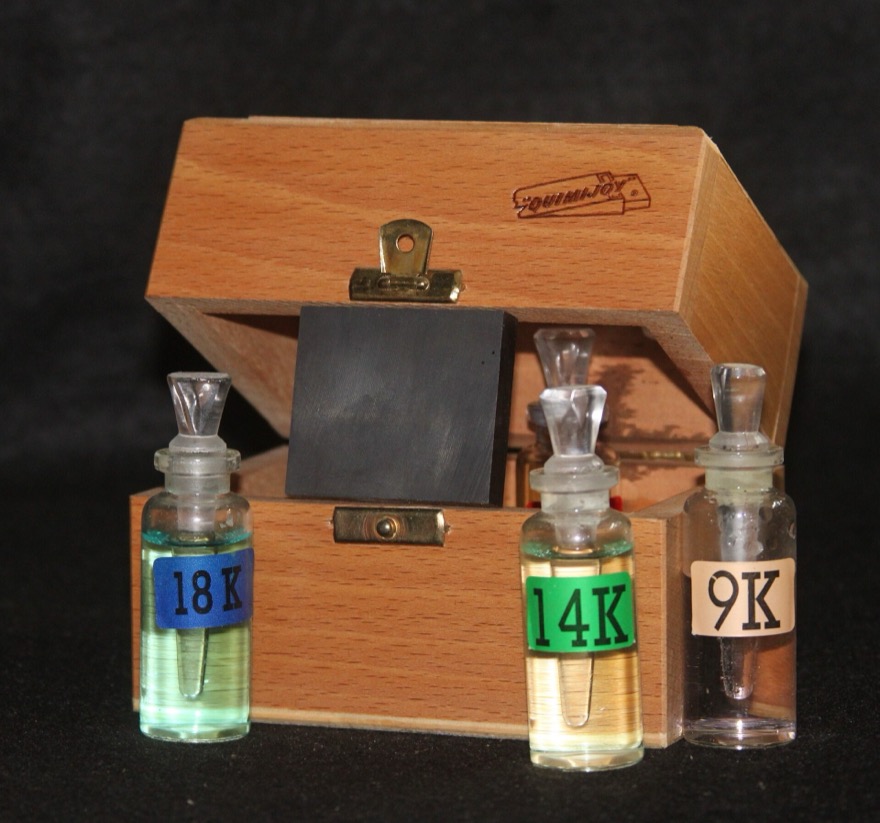

Save these for pieces you don't mind marking, or leave them to a jeweler.
- Ceramic streak. Rub the piece on unglazed ceramic. A black or dark grey streak points to base metal, and a gold or yellow streak suggests gold. It can mark the item, and plated pieces can still leave a gold-coloured streak.
- Acid. The traditional jeweler's method rubs the metal on a testing stone and compares its streak under graded acids with known samples. Measured nitric acid covers 14K and lower, and a mix of nitric and hydrochloric acid covers higher karats. GIA's instructors say a highly effervescent green reaction means base metal. If a piece may not be gold, they expose fresh metal first, because the surface may not match what's underneath. That means cutting into the piece, and the acids call for gloves, goggles and good ventilation, so it isn't a kitchen-table test.
Does the lighter test work?
The idea is to hold a lighter flame to the piece for a short while: real gold should come out unchanged, while a fake darkens. Gold is extremely unreactive and doesn't tarnish like most metals, so there is something to it, but it tells you less than it seems and can do real harm.
- It only tests the surface. A gold-plated piece has real gold on the outside, so it can pass. A jewelry insurer that describes the test calls it preliminary only and less reliable on electroplated pieces.
- Real gold can darken too. 10K gold is less than half gold. Jewelers routinely clean gold pieces after soldering to remove the surface oxide, such as copper oxide, that heat leaves on the metal. A little darkening doesn't prove a fake.
- It can damage the piece. Heat can spoil a thin plating. Stones are the bigger risk. GIA's guide to gemstone durability says heat can crack pearls or turn them brown, turn opal white or brown and destroy its play of colour, and make liquid inclusions in emerald, topaz and tourmaline expand until the stone fractures. It even notes that irradiated yellow sapphire fades quickly when held close to a simple flame.
Never put a flame to a piece with stones or pearls. The density test above answers the same question better and harms nothing.
Does real gold smell?
No. The "metallic" smell your hands pick up from coins, keys or cheap jewelry isn't the metal itself. Researchers at Virginia Tech found it is a body odour: sweat corrodes iron, and the iron breaks down oils on the skin into strong-smelling compounds. Nature reported that copper does the same, which is why copper-alloy coins smell. Gold barely reacts and doesn't tarnish, so it doesn't work this way.
So if rubbing a piece leaves a strong metallic smell on your fingers, iron or copper is probably at its surface, which points to base metal or plating worn through. Treat it as a weak hint. Karat gold below 24K is alloyed with other metals, and a plated piece that smells of nothing has proved nothing.
Popular tests that settle nothing
- The float test. You may read that real gold sinks and fake gold floats. Brass is more than eight times as dense as water, so a brass fake sinks too.
- The vinegar test. One jeweler who describes it calls it screening only, says it can't tell 9K from 18K, and says it can miss thick plating. A US refinery warns that vinegar can damage even 14K and 18K alloys. Another source disagrees about 18K, but with that little to gain, skip it.
- Marks on your skin. Green marks point to copper-heavy metals such as brass and bronze, and high-karat gold is unlikely to leave them. A clean finger proves nothing, because plenty of fakes leave no mark at all.
- The ping test. This compares the ring of a known coin type. It's of little use on jewelry.
Rather check yours from a photo? Worthzy identifies the piece, screens it for fakes and shows a price range from matching listings, in seconds.
Get Worthzy on the App StoreWhat each test can and can't tell you
| Test | Can catch | Can miss |
|---|---|---|
| Stamp | Plated and filled pieces marked as such | False stamps |
| Magnet | Steel and iron | Brass, copper, tungsten |
| Worn colour | Plating worn through | Unworn or thick plating |
| Density | Brass and most lighter metals | Tungsten core; unreliable with stones or hollow pieces |
| Ceramic streak | Pyrite and base metals | Plating |
| Lighter flame | Some base metals that darken | Plating; can harm stones and plating |
| Smell on your fingers | Iron or copper at the surface | Plating; fakes that leave no smell |
| Acid on fresh metal | Base metal; gives the karat range | Needs skill and known samples |
| Electronic tester | Karat of the metal it touches | Plating, unless filed or cut through |
| XRF at a jeweler | Alloy content, thin plating | A thick shell over another metal |
| Fire assay | The gold content itself | Very little, but it destroys the sample |
What a jeweler's or buyer's test can tell you
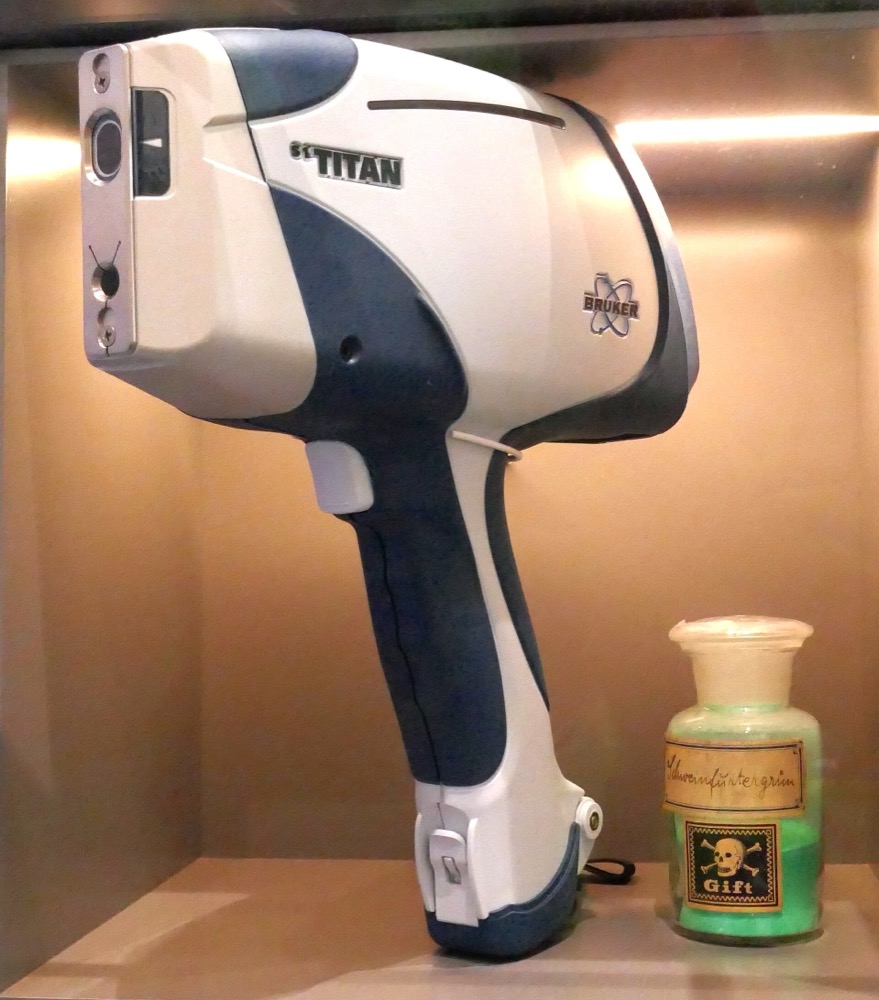

If a piece is heavy, signed or about to be bought or sold, have it tested by a jeweler, a refiner or an assay office. Each method answers a slightly different question, and only fire assay sees past the surface.
| Test | How it works | How accurate | What it can miss |
|---|---|---|---|
| Acid and touchstone | A streak on a black stone is compared with known samples under graded acids | The London assay office uses it for "an initial indication of the fineness" before the real assay | Plating, unless fresh metal is exposed first |
| Electronic tester | A probe touches the metal and the meter shows a karat band, such as 14K | Reads in karat bands, from 8K to 24K | Plated and gold-filled pieces, and tungsten or steel, unless filed |
| XRF | X-rays make the metal give off its own X-rays, which show what it's made of | About ±0.4% gold in a 10-second test, or ±0.2% with calibration for the job | A thick plating over another metal, which reads as solid gold |
| Fire assay | A sample is melted with lead in a cupel, the other metals are absorbed, and the gold left is weighed | About 1 part per thousand | Very little, but the sample is destroyed |
- Acid and touchstone. The London assay office still uses touch tests to check that a batch of articles is all the same fineness before it takes samples. The test reads only the streak, which is why GIA's instructors expose fresh metal first on a piece that may not be gold.
- Electronic testers. GemOro, which makes the AuRACLE testers, calls its tester a surface tester. Its manual says plated and gold-filled pieces may test as solid gold if they aren't filed to expose the base metal, and that thick gold may need cutting or sawing through. Unfiled tungsten or stainless steel can read as high-karat gold or even platinum. Other testers, such as the Sigma, measure how the metal resists an electromagnetic signal instead, without scratching it.
- XRF. It is fast and leaves no mark, and UK assay offices use it to check fineness for hallmarking. Evident, which makes XRF analysers, gives the accuracy figures above and says XRF reads only about the outermost 15 microns, so an 18K plating over a steel core, if thick enough, reads as solid 18K. For telling 14K (58.5% gold) from 18K (75%), XRF is far more precise than you need. The risk is the surface, not the decimal point.
- Fire assay. The Goldsmiths' Company Assay Office in London describes it: the sample is weighed, wrapped in lead with added silver, and heated to 1100°C in a porous cupel that absorbs everything except the gold and silver. The silver is then dissolved out in nitric acid and the gold is weighed again. ISO 11426 recommends it as the method for measuring the fineness of gold jewelry, and the Sheffield Assay Office uses it to check its XRF instruments. It destroys the metal it tests, so an assay office cuts or scrapes a small sample from the piece, while some refiners melt and assay whole pieces they buy.
If a buyer's test is surface-only and the piece might be plated, ask them to test where it has been filed, or in a hidden spot. A genuine UK hallmark means an assay office has already tested the piece.
What real gold sells for
Once you know it's gold, plain pieces are priced mostly by their metal, so you can work it out yourself: weight in grams × purity × the day's spot price per gram. Purity is 0.417 for 10K, 0.585 for 14K and 0.75 for 18K. Spot is quoted per troy ounce, so divide by 31.1 for the gram price. Buyers rarely pay full melt value because refining costs money, so get more than one offer. Our gold stamps guide goes through the calculation step by step.
Before selling for scrap, check whether the piece is worth more than its gold. A known maker, fine workmanship, a collectible period or a good stone can all lift the price, so search eBay for similar pieces and filter by Sold Items. Asking prices only show what sellers hope for. If you're sorting a whole box of jewelry, how to value inherited antiques covers what to do first. A gold watch needs its own checks, so see how to tell if a watch is fake.
Gold and silver stamp lookup: type the stamp on your piece to see what it claims before you test it.
Sources
- 16 CFR § 23.3: Misrepresentation as to gold content, Legal Information Institute, Cornell Law School
- 15 U.S. Code § 297: Stamping plated articles, Legal Information Institute, Cornell Law School
- Touchstone Method for Testing Karat Gold Purity, Ganoksin, from GIA's jewelry arts instructors
- Jewellery testing in the 21st Century, Sheffield Assay Office
- Meet the guardians of gold, Chemistry World
- How to Test Gold: A Complete Guide, BullionStar
- The Hallmarking Process, The Goldsmiths' Company Assay Office
- Gold Analysis Testing Guide: XRF gold testing and fake detection, Evident
- AuRACLE PRO Digital Gold & Platinum Tester: easy operation guide and user manual, GemOro
- ISO 11426:2021 Jewellery and precious metals: determination of gold, cupellation method (fire assay), Estonian Centre for Standardisation and Accreditation
- Gemstone Durability: Design to Display, Gems & Gemology, Gemological Institute of America
- A 'metallic' smell is just body odour, Nature News
- The properties of gold, OpenLearn, The Open University
- How to tell if gold is real using a lighter, BriteCo
Related guides
Not sure about a piece?
Photograph it and a close-up of its stamp. Worthzy reads the mark where it can, gives a value range from comparable listings, and says so when a photo can't settle it. A photo can't test the metal itself, so have anything valuable tested in person.
Get Worthzy on the App StoreWorthzy gives estimates and an authenticity screening, not a certified appraisal. For anything valuable, have a qualified specialist examine it in person.